
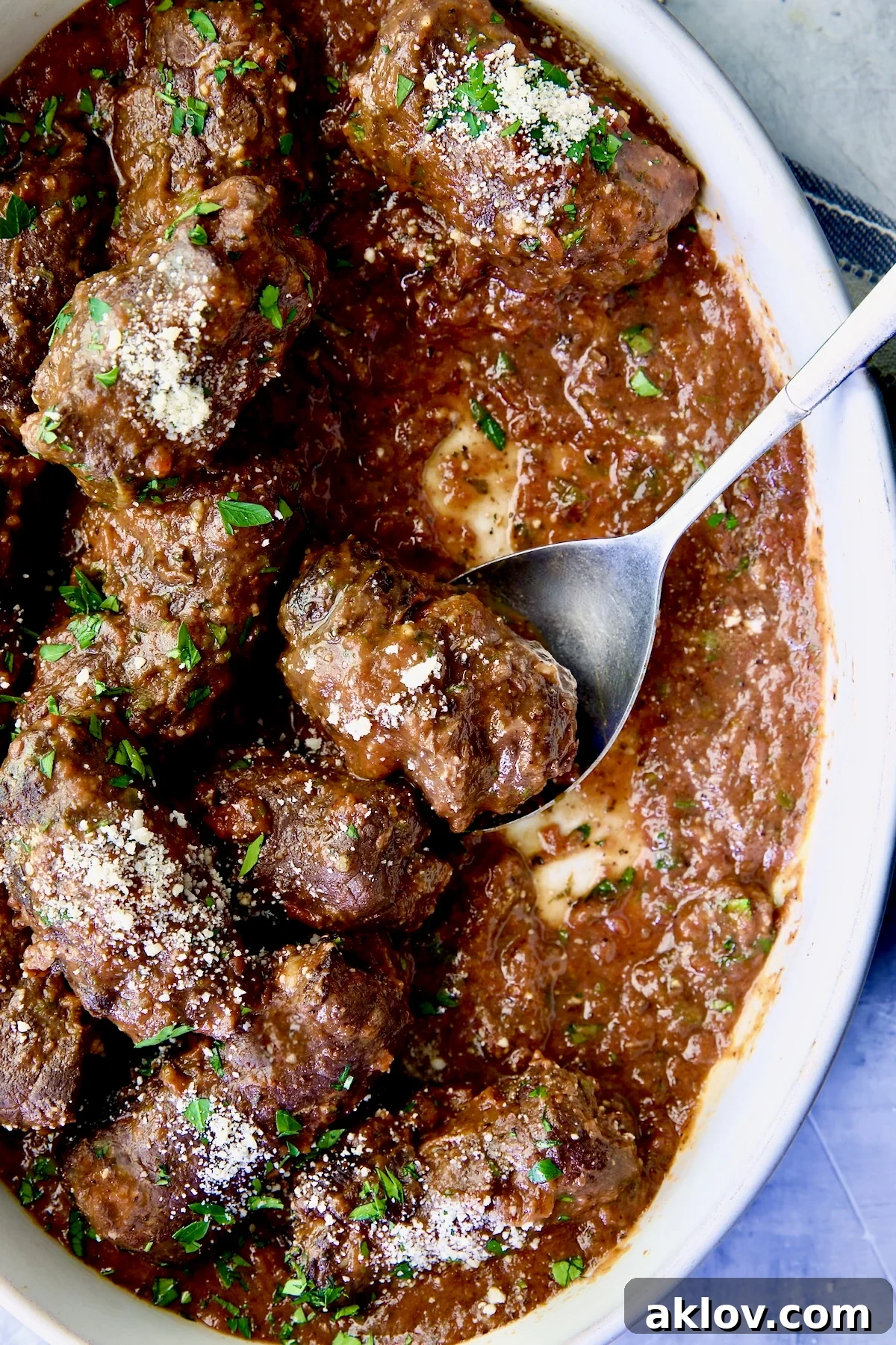
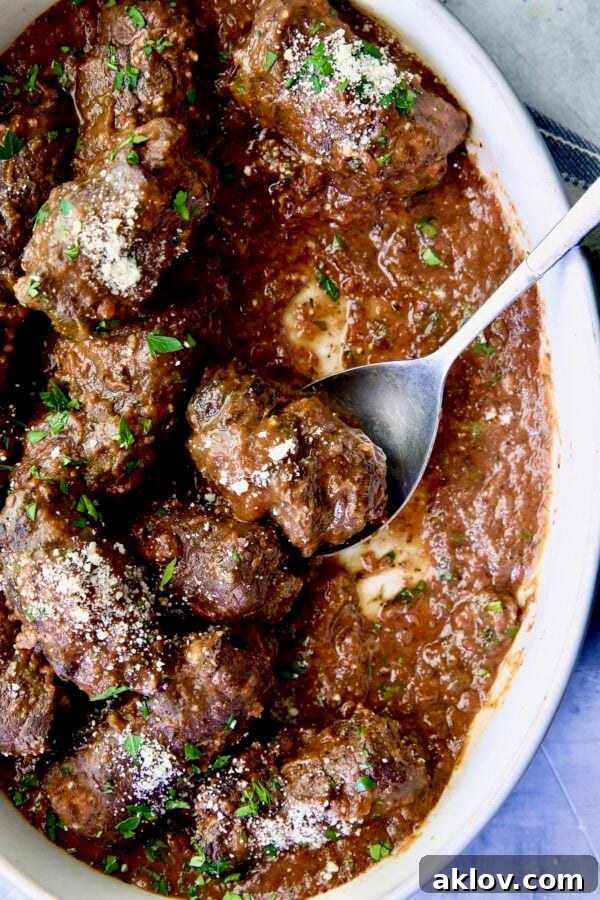
For over two decades, I’ve dedicated myself to perfecting this **Beef Braciole recipe** for my personal chef clients. It’s a classic, heartwarming, and truly authentic Italian-American dish that’s ideal for a cozy Sunday dinner, holiday gathering, or any occasion where you want to deeply impress your guests. Once you try it, you’ll understand why it consistently earns hundreds of 4 and 5-star ratings, making it one of the most beloved braciole recipes available!
“This is my new go-to recipe. Loved the sauce, so much better than traditional tomato sauce I used in the past.”
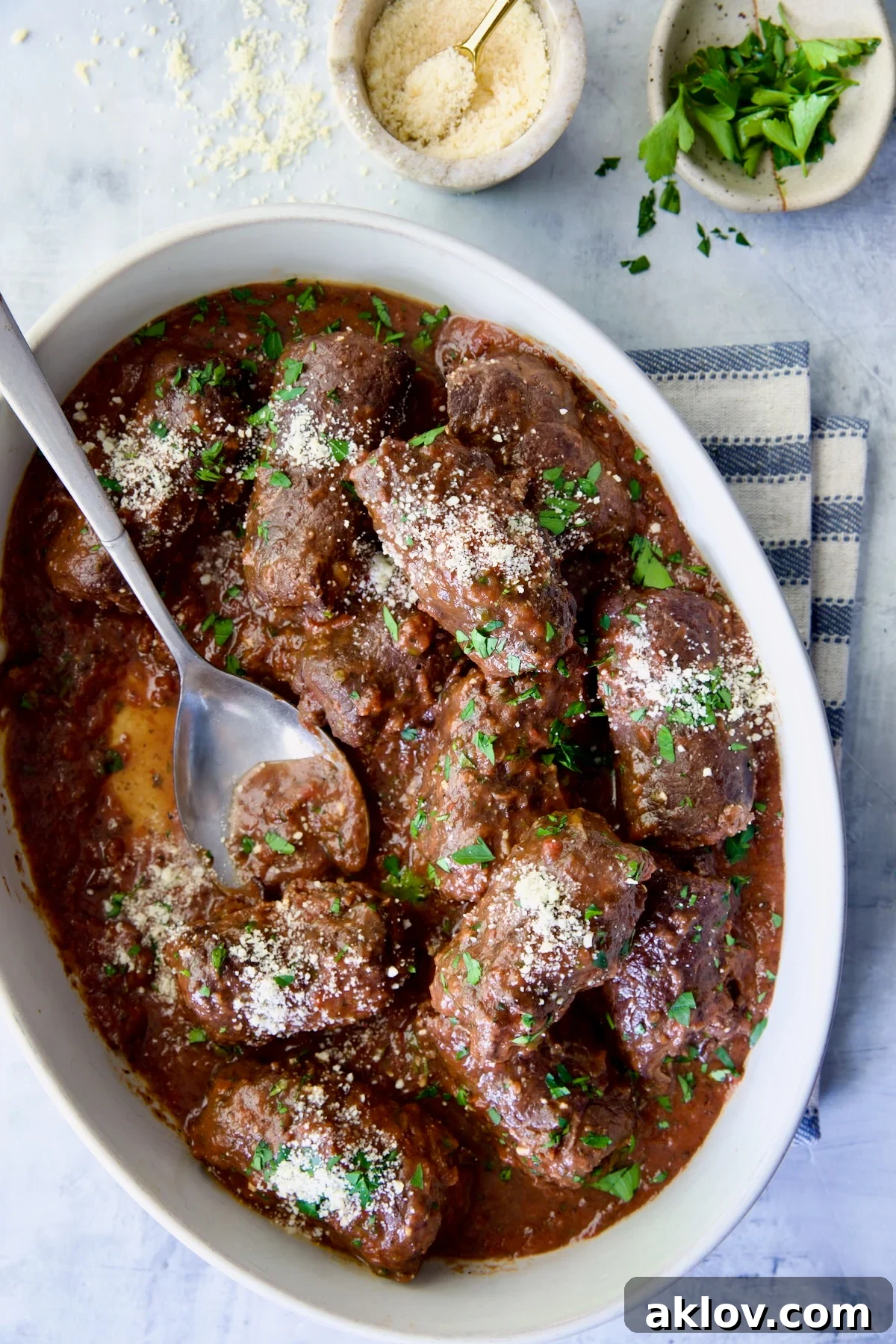
What Exactly is Beef Braciole?
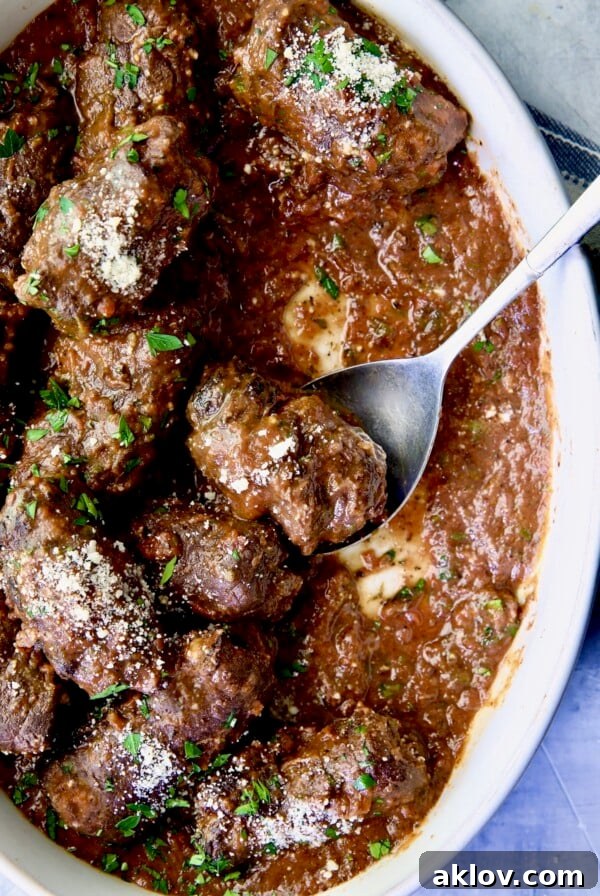
Beef Braciole (often spelled Braciola, or sometimes called Involtini, and known as Bruciuluni in Sicilian dialect) is a traditional Italian and Italian-American dish. It’s essentially a savory meat roulade, prepared by rolling thinly sliced beef around a flavorful filling. While beef top round is a popular and economical choice, other cuts like flank steak are sometimes used in braciole recipes. Occasionally, you might even find pork braciole, showcasing the versatility of this beloved preparation.
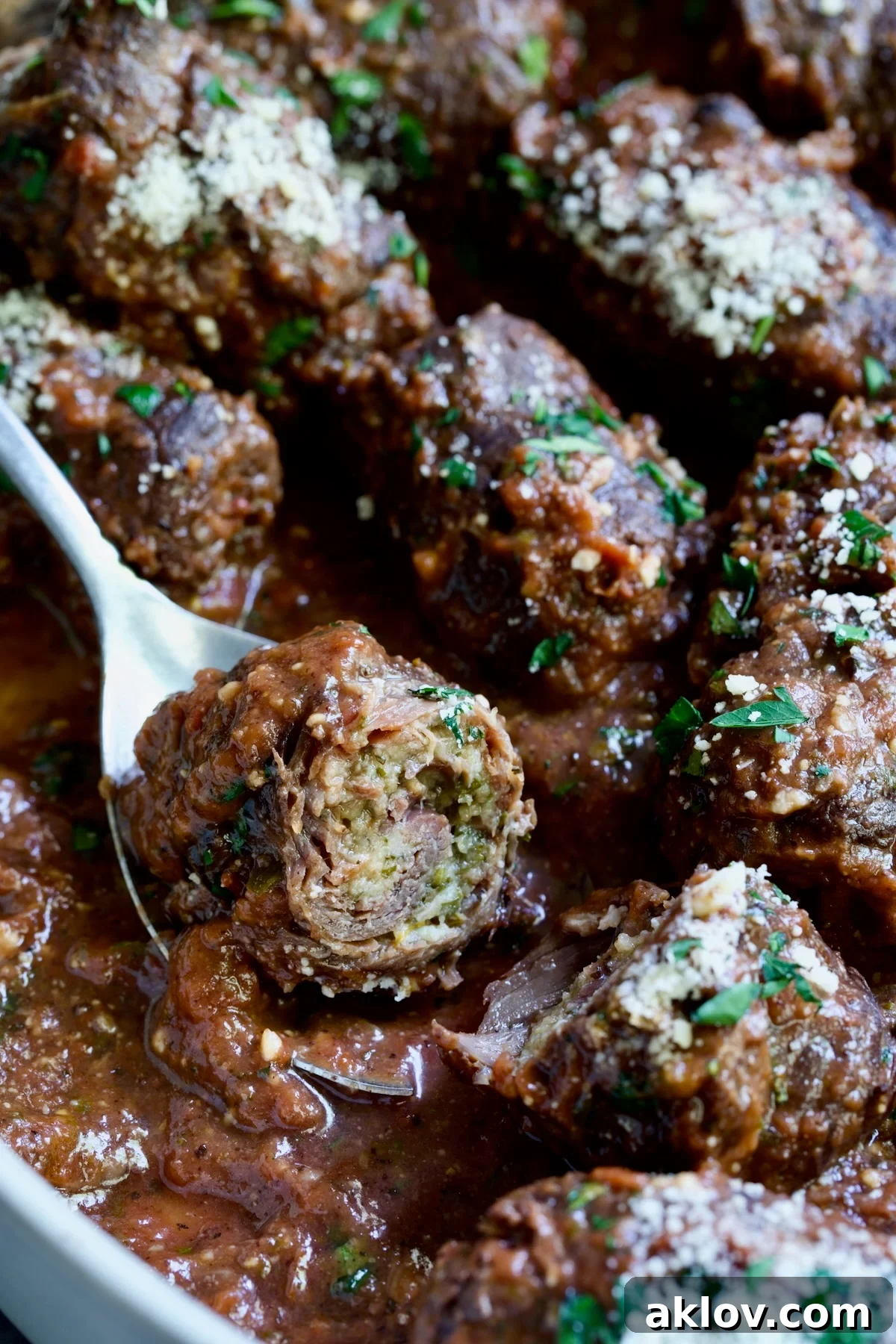
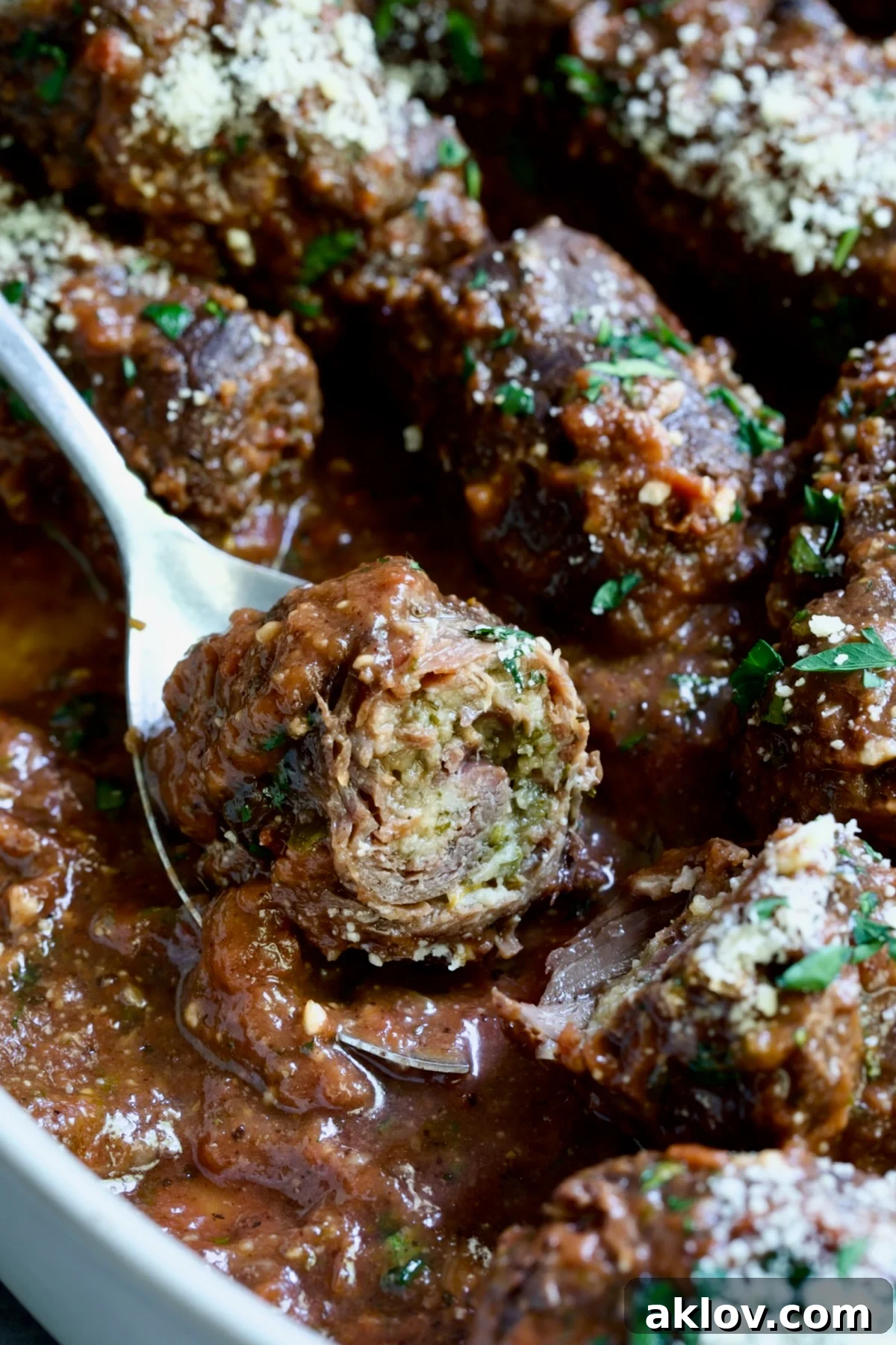
The essence of an authentic Italian braciola lies in its rich and aromatic filling. Typically, this includes a robust blend of breadcrumbs, grated hard cheese (like Parmesan or Pecorino Romano), fresh garlic, aromatic herbs, and often cured meats such as prosciutto or pancetta. Depending on regional variations or individual family traditions, fillings can also incorporate unexpected yet delightful ingredients like raisins for a hint of sweetness, pinenuts for texture, or spinach for a touch of greens. Each component contributes to the depth of flavor that makes braciole so irresistible.
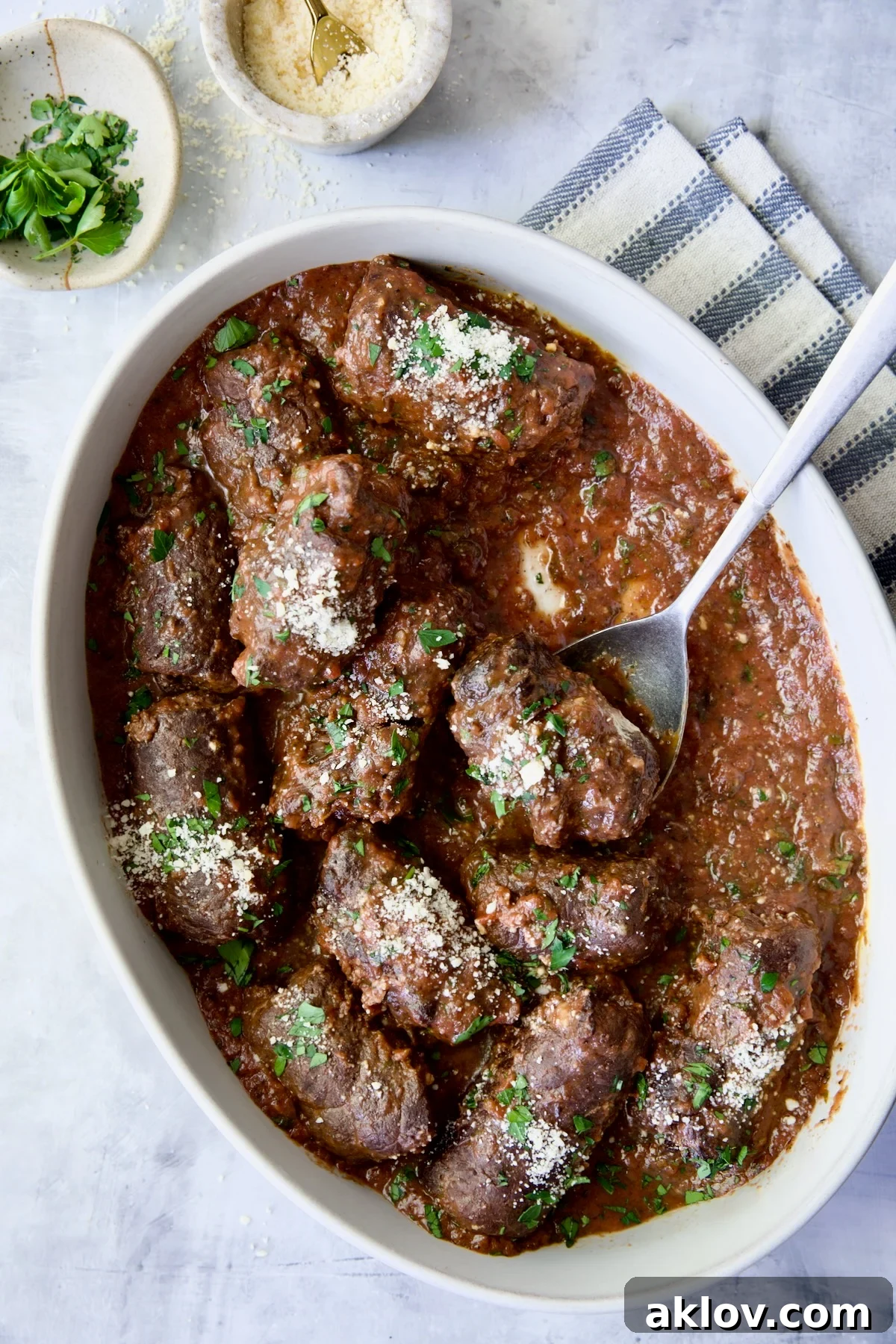
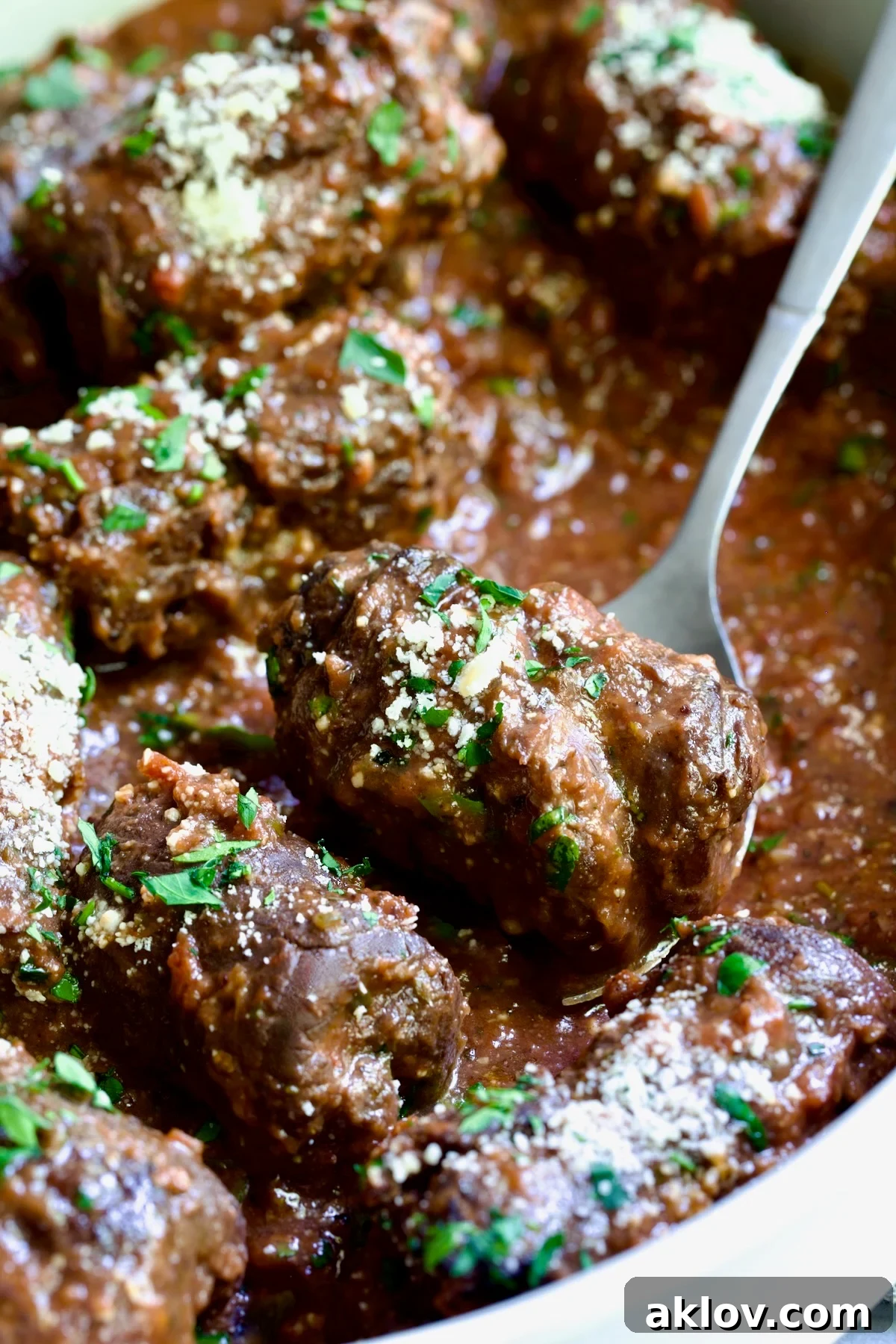
After being meticulously rolled and secured, these beef braciole bundles are first seared to a beautiful golden-brown, locking in their juices and developing a rich exterior crust. They are then slow-braised in a vibrant tomato-based sauce, often enhanced with a splash of wine and infused with savory aromatic vegetables. This extended slow-cooking process is crucial; it gently tenderizes the beef, transforming a lean, tough cut into melt-in-your-mouth perfection. The result is a truly comforting, deeply flavorful, and incredibly satisfying dish that embodies the heart of Italian cooking.
Beef Braciole has even graced pop culture, famously featured in an episode of Everybody Loves Raymond as the only dish Ray Barone’s wife, Debra, could successfully master—a testament to its iconic status in Italian-American cuisine.
Regardless of the specific filling or meat cut you choose, Beef Braciole promises a delicious, hearty, and authentic Italian-style meal that is sure to become a cherished favorite in your kitchen.
Why This Braciole Recipe is a Keeper!
My journey to perfecting this Beef Braciole recipe began when a client, a devoted fan of The Sopranos, requested I prepare a recipe from The Sopranos Family Cookbook. With a few thoughtful tweaks and enhancements, this Italian braciole recipe quickly became a signature dish on my personal chef menu, a favorite among my discerning clientele.
Since its initial publication, this recipe has garnered immense popularity, being pinned nearly 100,000 times and receiving hundreds of glowing 4- and 5-star ratings. It stands out as one of the most highly-rated Beef Braciole recipes on the internet, a testament to its exceptional flavor and foolproof instructions.
Here’s why this Beef Braciole recipe truly stands out:
- **Approachable for All Skill Levels:** While it involves several steps, the overall process is straightforward and does not require complex culinary techniques. Many home cooks are surprised by how easy it is to achieve such an impressive result.
- **Excellent for Meal Prep:** This recipe offers remarkable flexibility for making ahead at various stages. You can prepare the components in advance, making it perfect for busy weeknights or entertaining.
- **Reheats Beautifully:** Like many slow-braised dishes, Beef Braciole often tastes even better the day after it’s made, as the flavors have more time to meld and deepen. It reheats perfectly, retaining its tender texture and rich taste.
- **Freezer-Friendly:** This dish freezes exceptionally well, allowing you to enjoy a delicious, homemade Italian meal whenever the craving strikes, with minimal effort. Simply thaw and reheat.
Ready to create your own authentic Italian Beef Braciole? Let’s dive into the delicious details!
How to Make Beef Braciole: A Step-by-Step Guide
Recipe Ingredients:
Gathering the right ingredients is the first step to creating truly exceptional Beef Braciole. Here’s a comprehensive list of everything you’ll need. Exact quantities are detailed in the recipe card below.
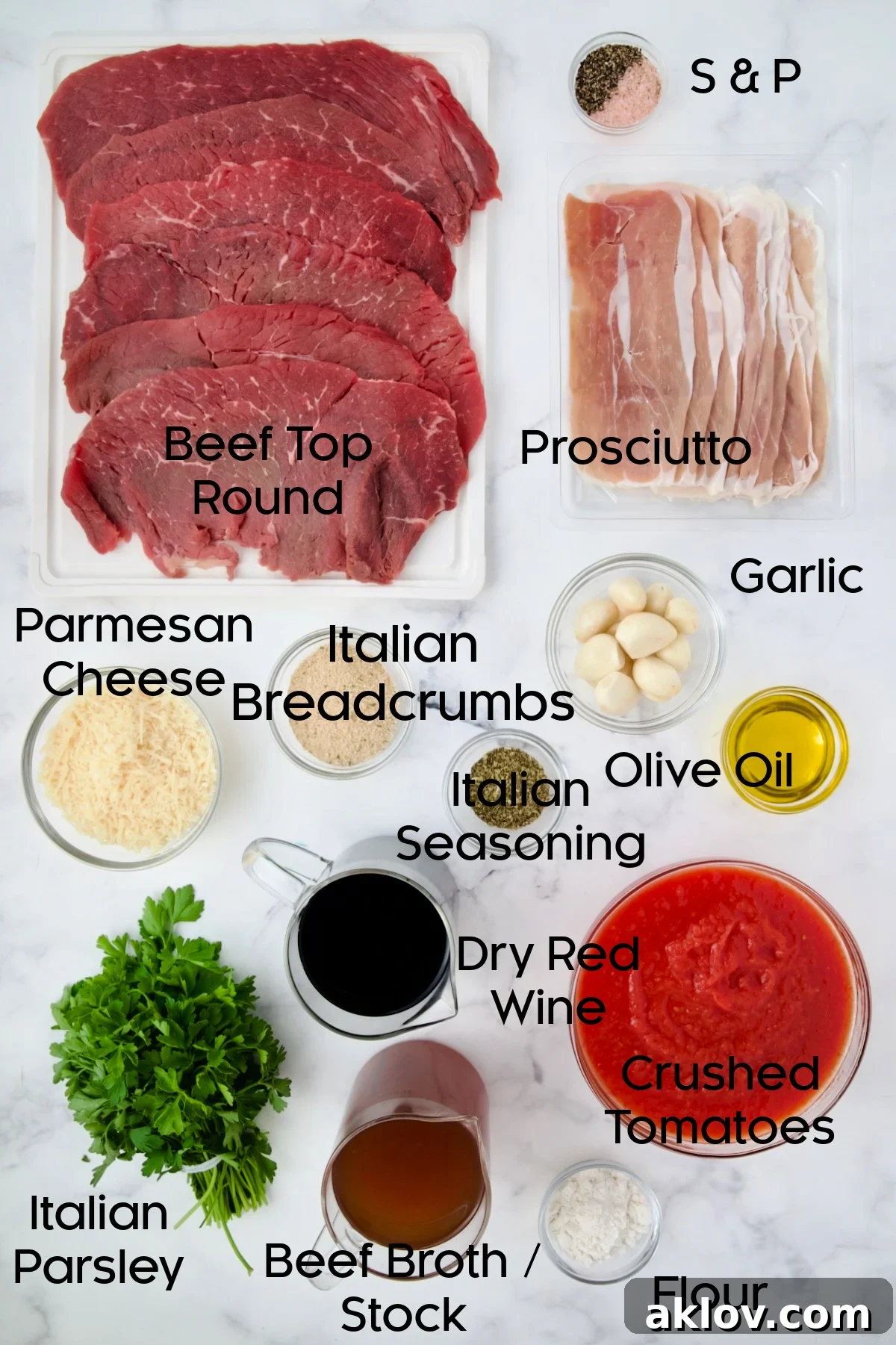
Ingredient Notes and Essential Substitutions:
- Beef Top Round: This cut is ideal for Italian braciole due to its lean nature and budget-friendly price point. While typically tough, thinly slicing and thoroughly pounding the meat (as instructed in this recipe) breaks down the fibers, yielding exceptional tenderness after slow braising. Look for “Milanesa” cut beef at your local butcher or grocery store, as it’s often pre-sliced for dishes like braciole. Thinly sliced sirloin roast is a suitable alternative if top round is unavailable.
- Prosciutto: Known as Parma ham, prosciutto adds a wonderful salty, savory depth to the braciole filling. Both domestic (U.S.-produced) and imported Italian varieties are widely available, typically near the deli section of your supermarket. For this recipe, domestic prosciutto works perfectly and can offer a cost-saving advantage without compromising flavor significantly.
- Italian Breadcrumbs: These are seasoned dry breadcrumbs, already infused with classic Italian herbs like oregano, basil, garlic, and parsley. Using them simplifies the filling preparation and ensures a consistent, aromatic base. If you only have plain breadcrumbs, you can easily season them yourself with a teaspoon of Italian seasoning, a pinch of garlic powder, and a dash of dried parsley.
- Italian Seasoning: A fundamental pantry staple, this herb blend typically comprises dried basil, oregano, rosemary, thyme, and marjoram. It provides a balanced, authentic Italian flavor profile to the sauce and complements the filling beautifully.
- Dry Red Wine: When cooking with wine, the golden rule is to use a wine you would genuinely enjoy drinking. An inexpensive but palatable wine is far better than a “cooking wine” of poor quality, which can impart undesirable flavors to your dish. I often opt for a Cabernet Sauvignon for its full-bodied richness, which adds complexity to the braising liquid. However, lighter-bodied options like Pinot Noir or Merlot will also yield excellent results.
- NON-ALCOHOLIC SUBSTITUTION: For those who prefer not to use alcohol, a fantastic substitute is beef broth with 2 tablespoons of good quality balsamic vinegar added. The vinegar provides a similar acidity and depth that wine would, balancing the richness of the tomatoes. You can adjust the amount of balsamic vinegar to taste after the beef has cooked. Red wine vinegar is another viable option for a tangy kick.
- Crushed Tomatoes: The quality of your tomatoes significantly impacts the final sauce. Invest in the best canned crushed tomatoes you can find, such as San Marzano tomatoes. While they might be slightly more expensive, their exceptional sweetness and low acidity are worth the investment for an authentic Italian flavor. Brands like Mutti are also excellent choices for their fresh, vibrant tomato taste.
Step-By-Step Instructions for Making Beef Braciole:
- Begin by gathering and prepping all your ingredients. This mise en place will ensure a smooth cooking process.
- Preheat your oven to 325 degrees Fahrenheit (160°C).
- Take your boneless top round slices and cut each in half widthwise, aiming for 12 equally sized pieces.
- Place each beef slice on a sturdy cutting board. To prevent tearing and splattering, place a zipper-top plastic bag over each beef slice.
- Gently pound each beef slice with a meat mallet to an even thickness of 1/4 to 1/8-inch. This tenderizes the meat and makes it easier to roll.
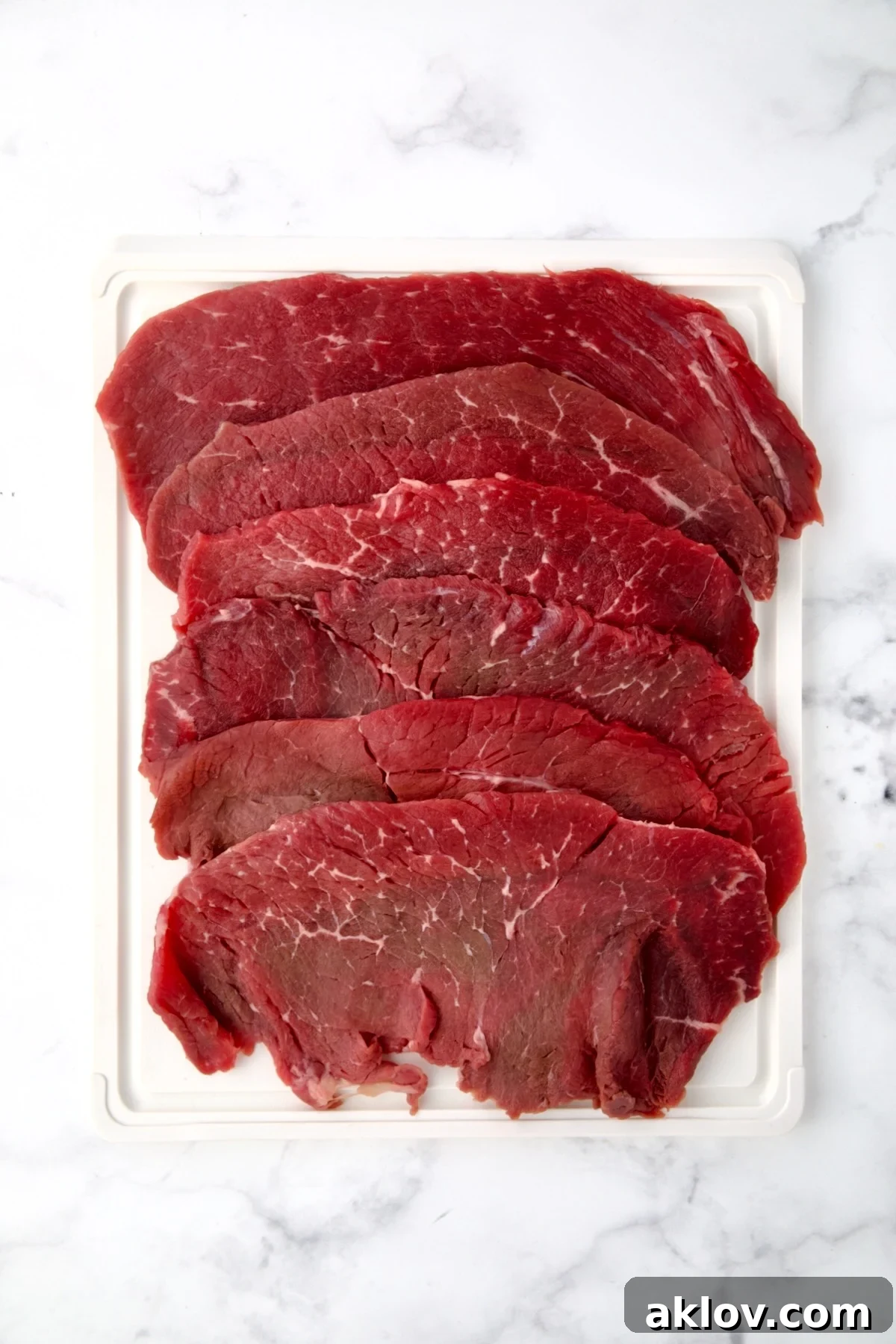
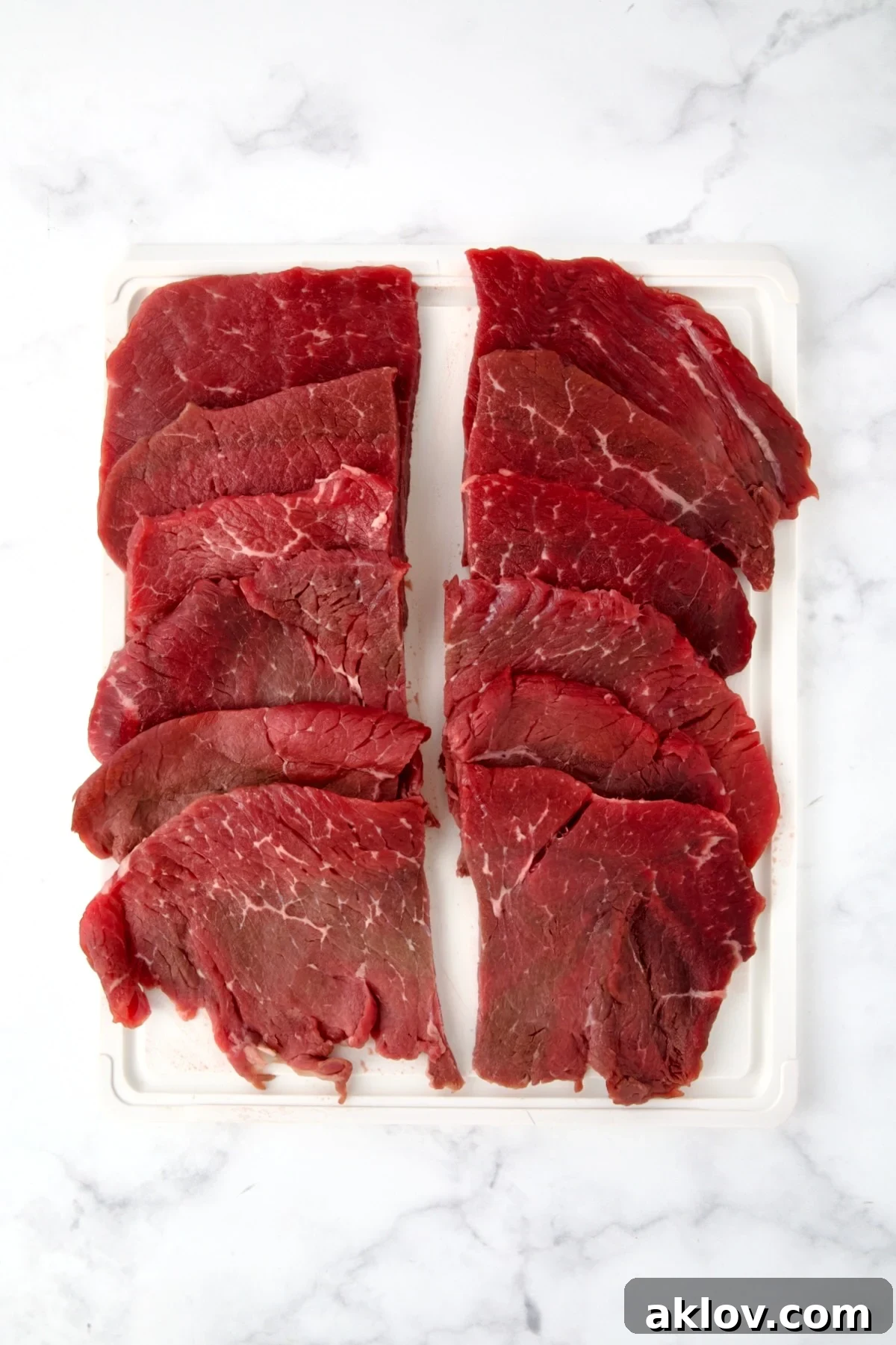
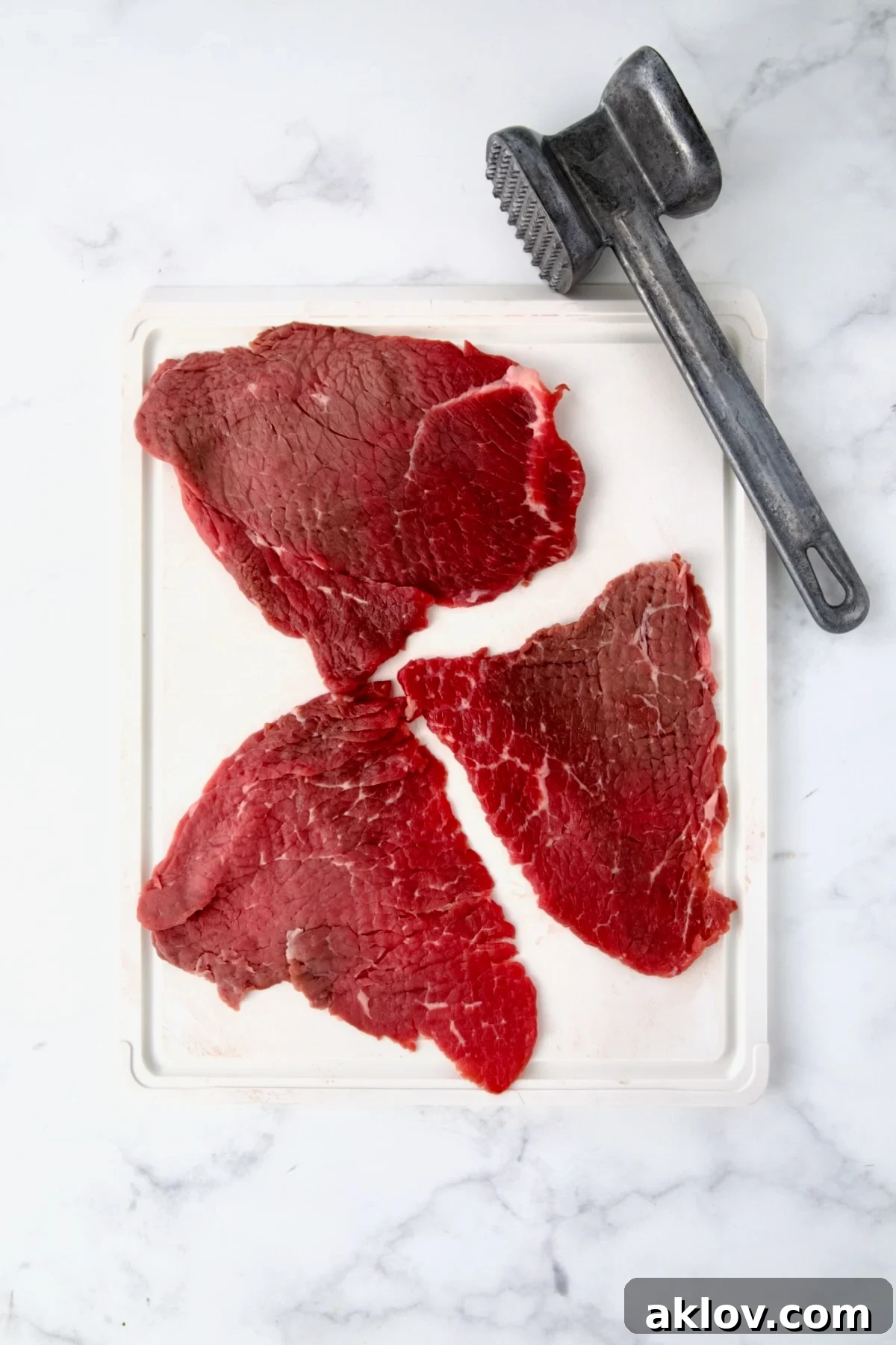
- Mince 4 cloves of garlic very finely. Slice the remaining 8 cloves of garlic thinly; these will go into the sauce.
- In a small mixing bowl, combine the minced garlic, chopped Italian parsley, shredded Parmesan or Romano cheese, seasoned dry breadcrumbs, and salt and freshly ground black pepper to taste. Mix well to create your savory braciole filling.

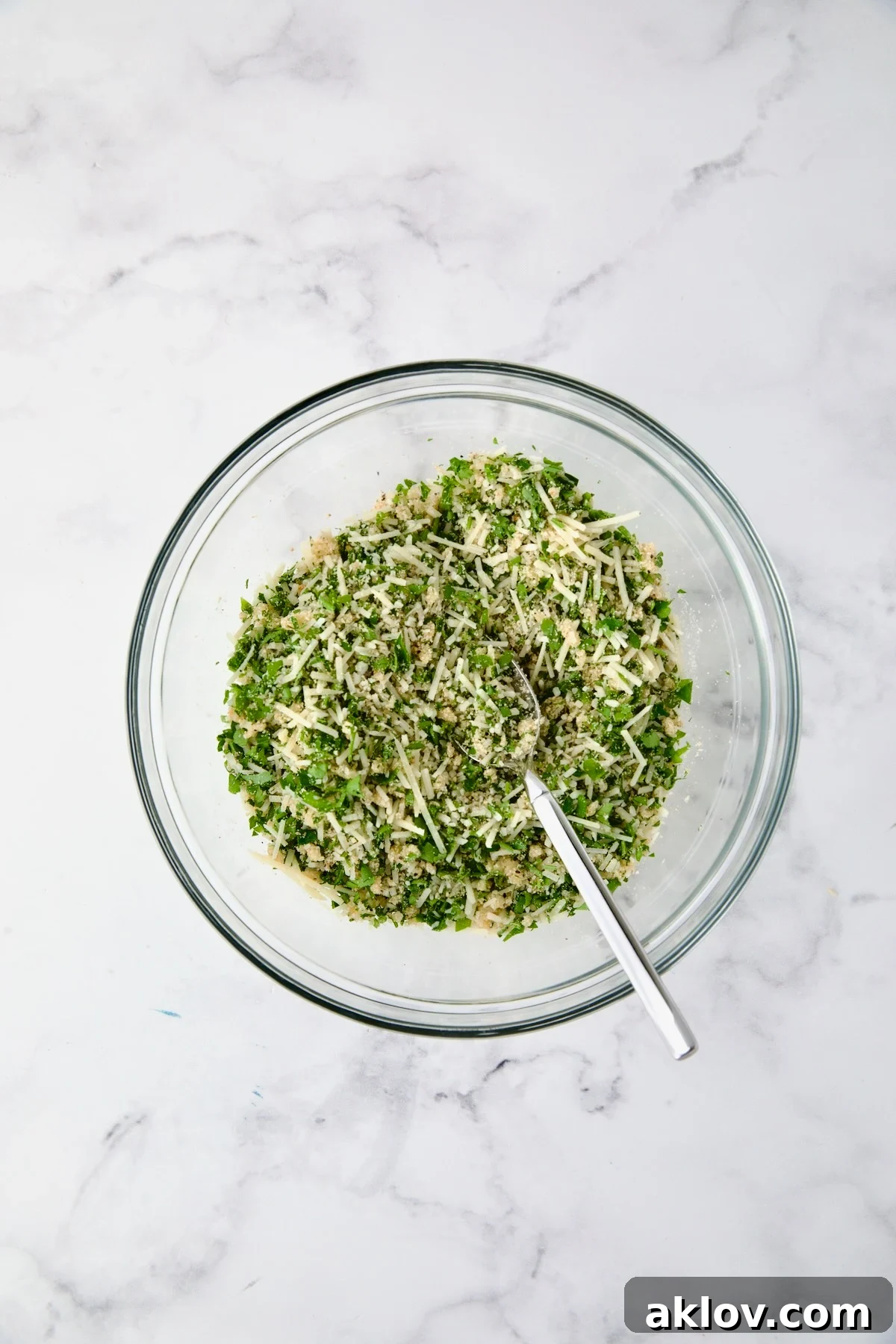
- Lay a thin slice of prosciutto over each pounded piece of beef. Then, evenly sprinkle the prepared filling over the prosciutto-covered beef slices. Aim for about 2 to 3 tablespoons of filling per slice.
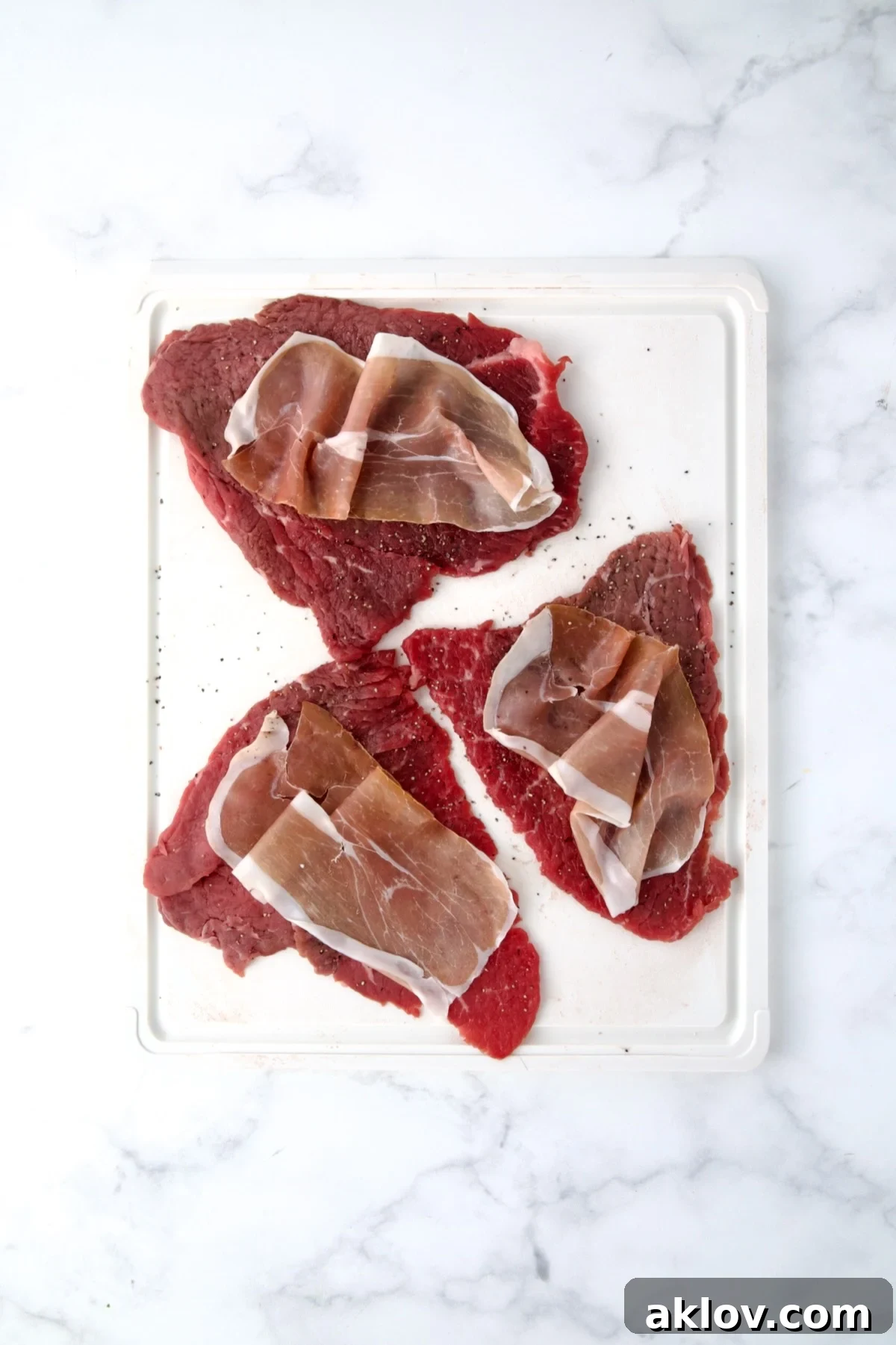
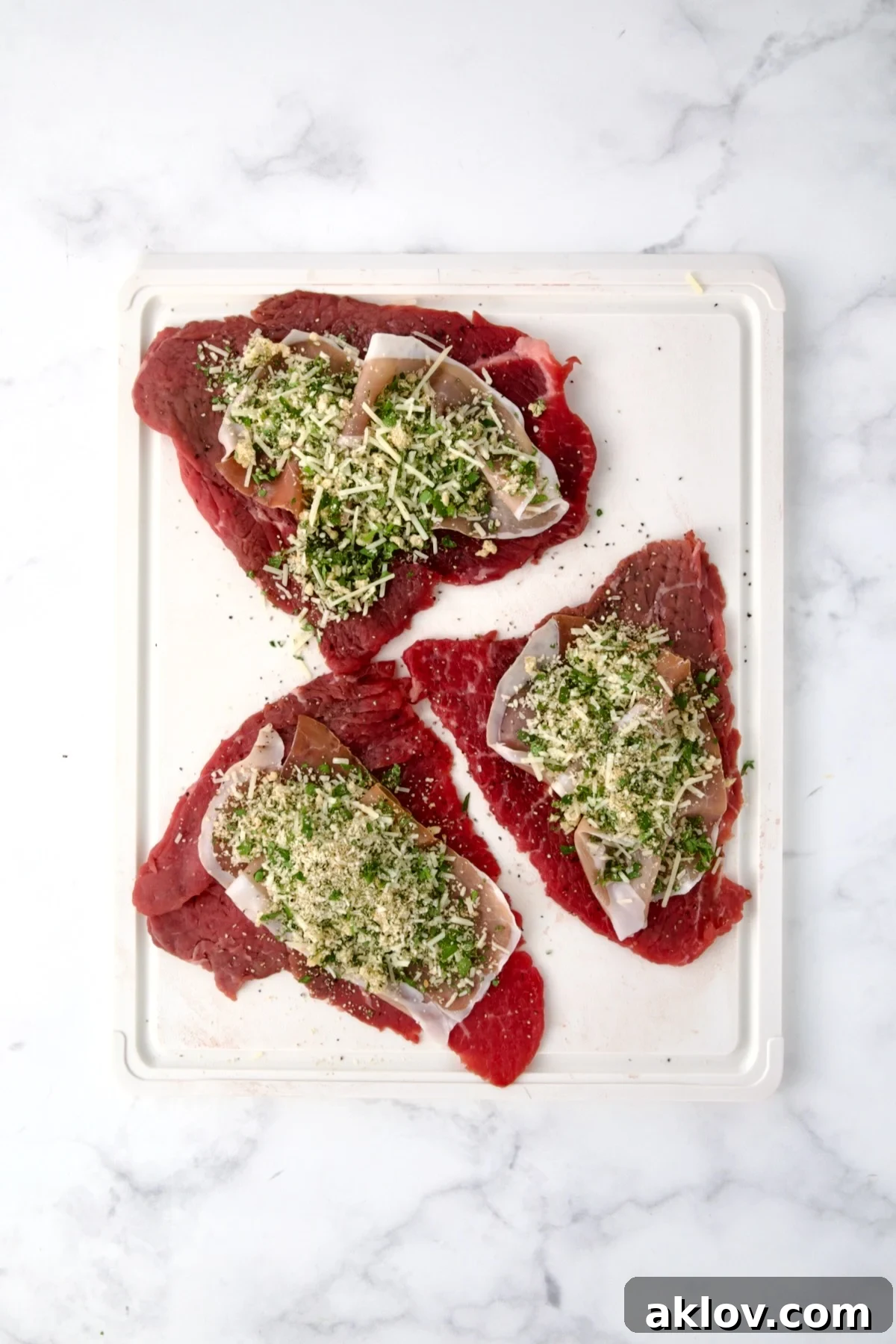
- Carefully roll each filled beef slice into a tight cylinder. As you roll, remember to tuck in the sides to ensure the filling remains securely inside. Once rolled, secure each braciole with one or two sturdy toothpicks to maintain its shape during cooking.
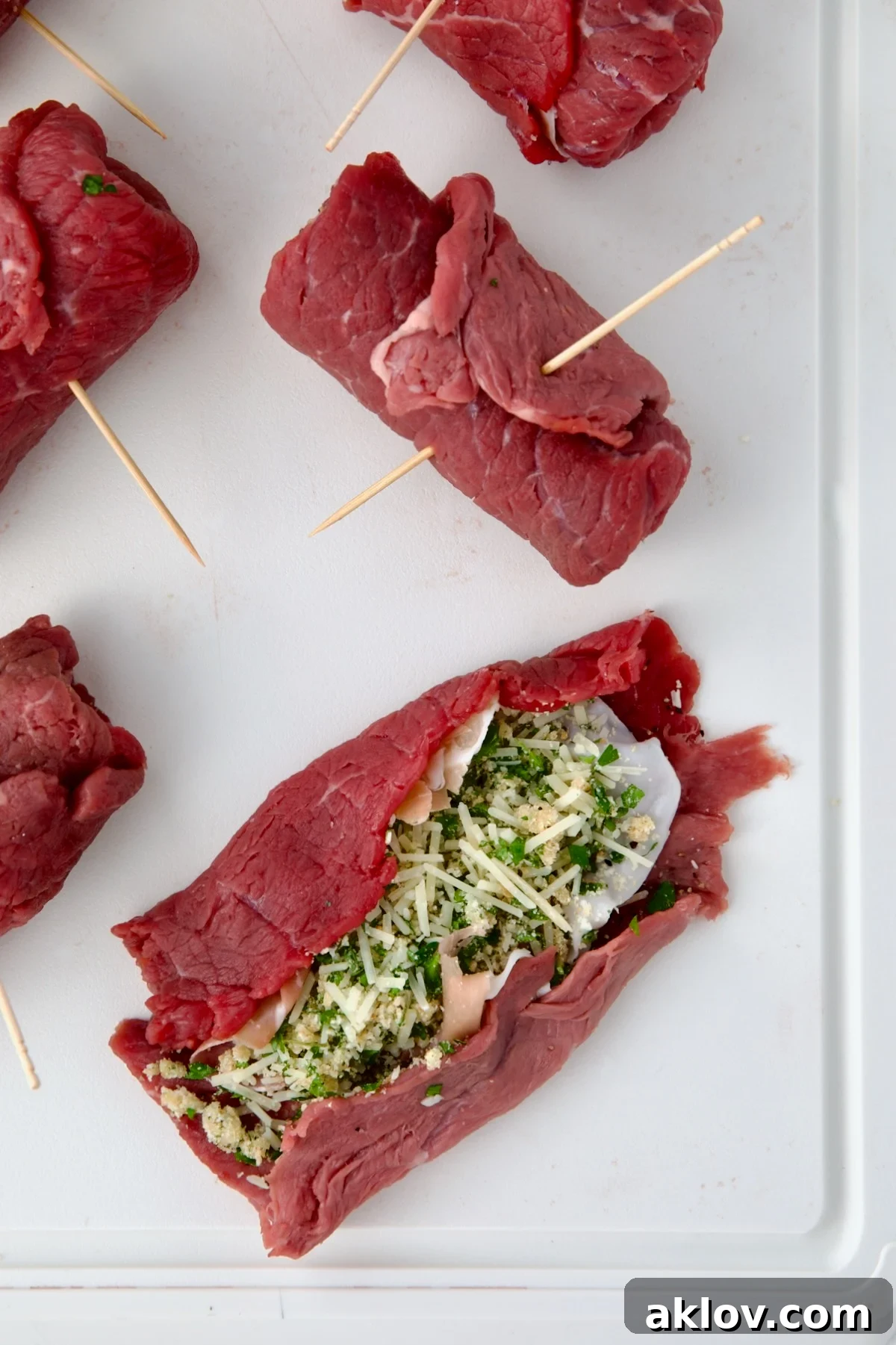
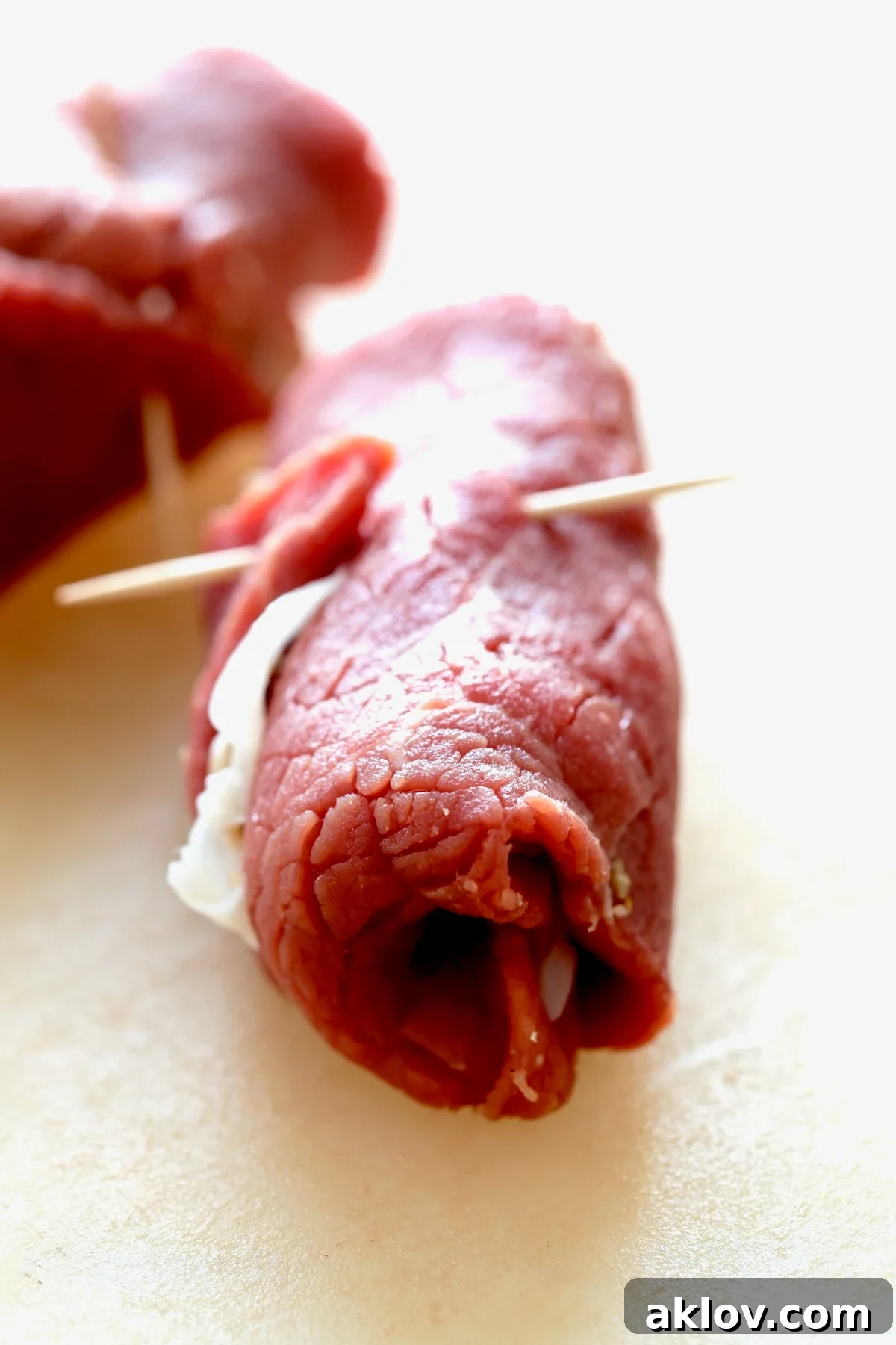
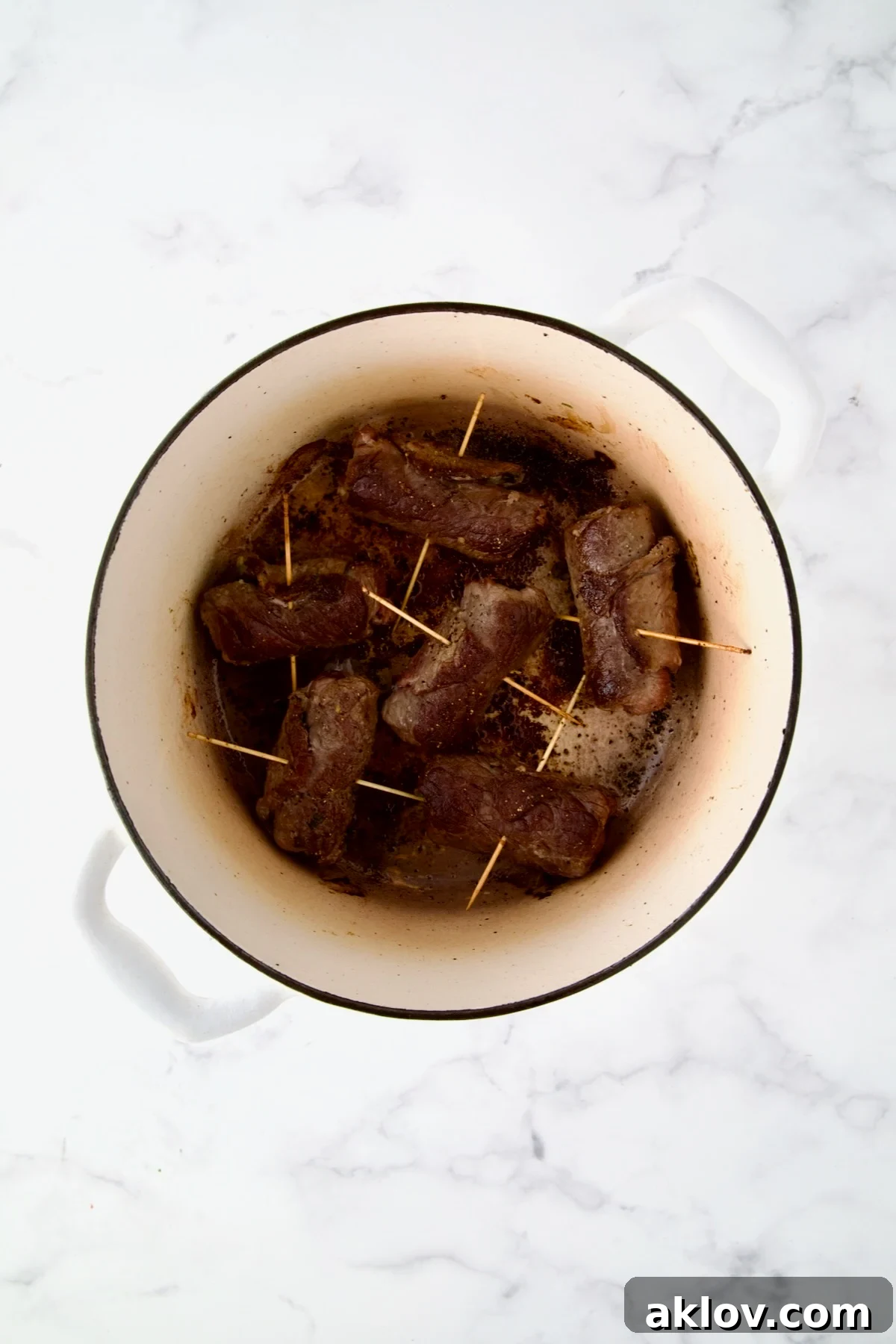
- Heat the olive oil in a large Dutch oven or heavy-bottomed pot over medium-high heat. Once shimmering, add the beef rolls in two batches of six each. Place them seam-side down first; this helps to seal the rolls and keep the filling intact. Cook, turning occasionally, until each braciole is beautifully browned on all sides, adjusting the heat as needed to prevent scorching. Transfer the browned braciole to a plate and repeat with the remaining rolls.
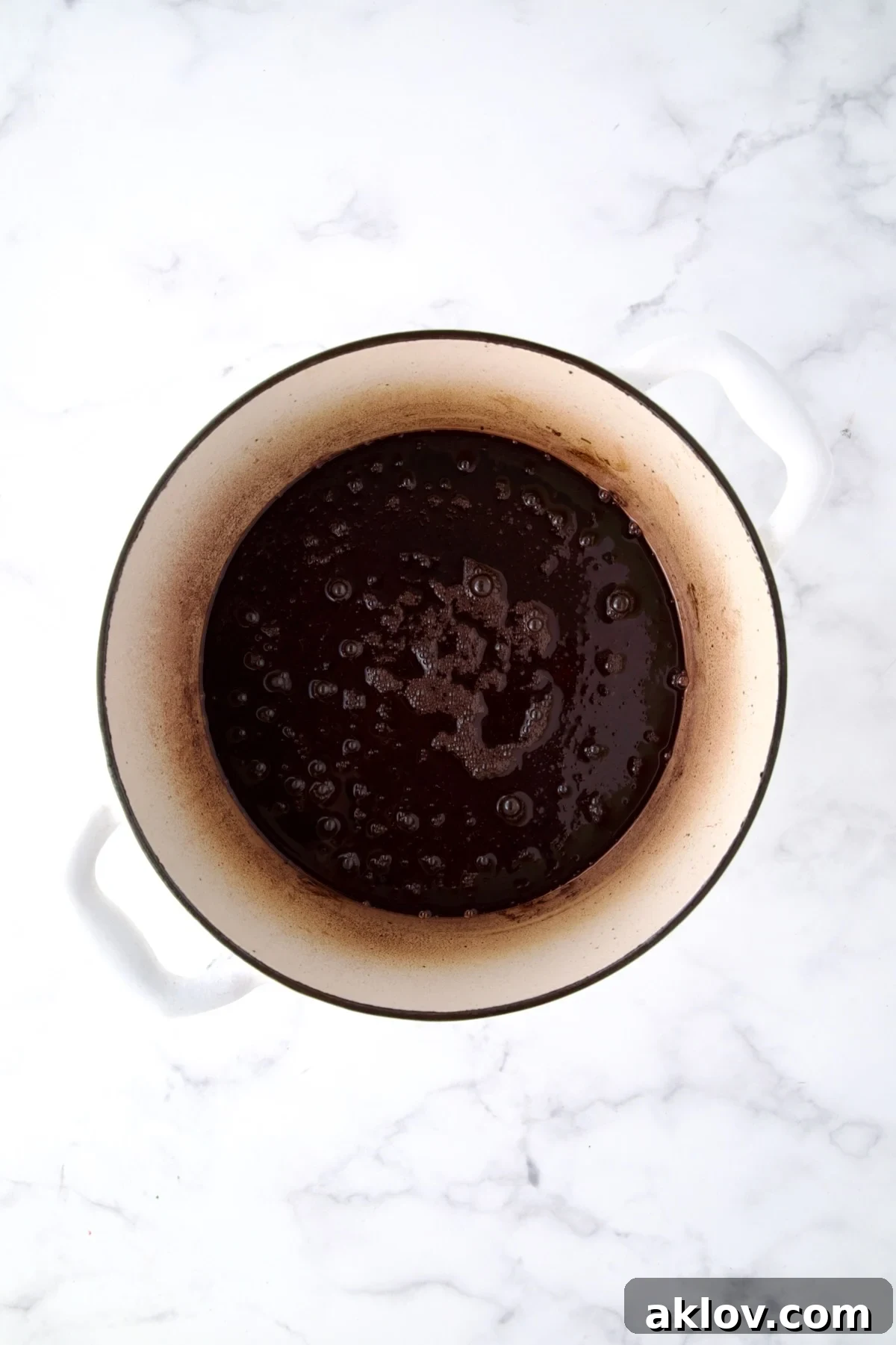
- Deglaze the pot by pouring the dry red wine into the hot Dutch oven. Bring it to a rolling boil, using a wooden spoon to scrape up any delicious browned bits (fond) from the bottom of the pot. Allow the wine to boil vigorously for 2 to 3 minutes; this reduces the wine and cooks off some of the alcohol, concentrating its flavor.
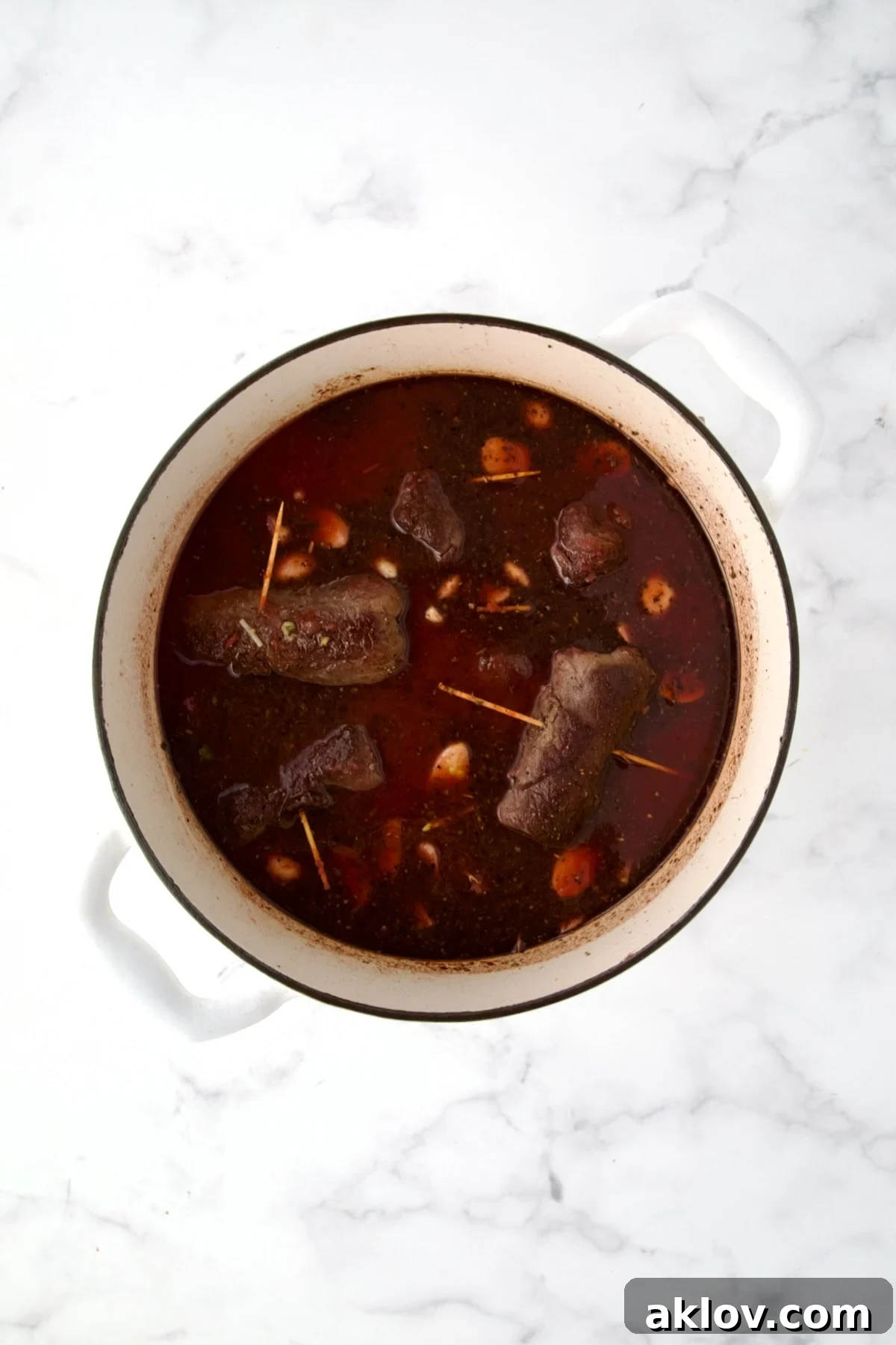
- Into the Dutch oven, add the beef broth, crushed tomatoes, sliced garlic, and Italian seasoning. Stir everything together. Return the browned beef rolls to the pot, nestling them into the sauce, and bring the mixture back to a gentle simmer.
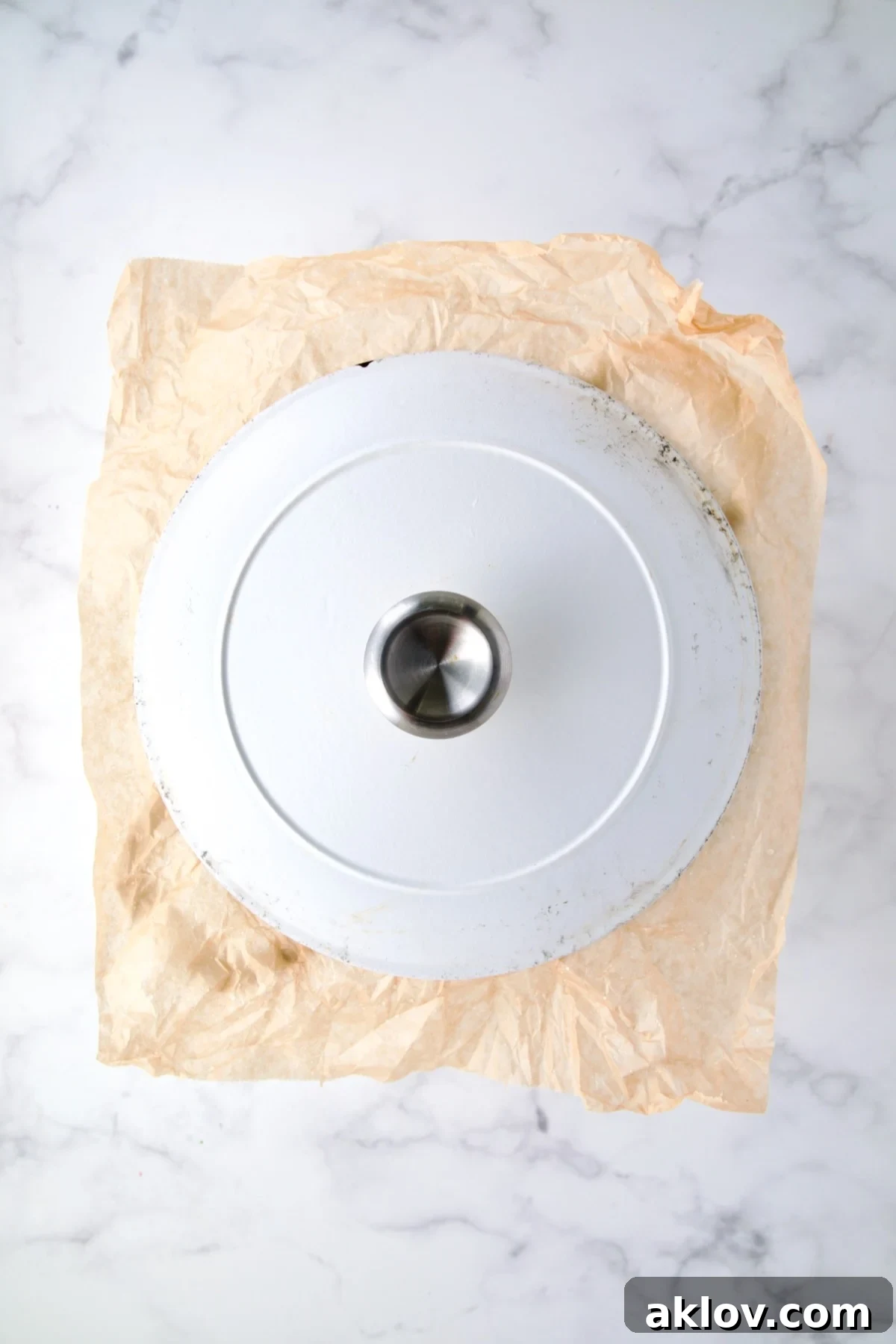
- To ensure a moist braise, place a piece of dampened parchment paper (or aluminum foil) directly over the surface of the sauce and beef rolls, then secure the lid tightly over the pot.
- OVEN Method: Place the covered Dutch oven into your preheated 325-degree F (160°C) oven. Cook for 1 1/2 to 2 hours, turning the rolls gently after 1 hour to ensure even cooking. My preferred cooking time for optimal tenderness is typically around 1 hour and 45 minutes.
- STOVETOP Method: If you prefer to cook on the stovetop, cover the pot tightly and simmer on low heat, turning the braciole occasionally, until the beef is fork-tender (easily pierced with a fork), approximately 1 1/2 hours. Ensure the heat remains low and consistent to avoid boiling, which can toughen the meat.
- SLOW COOKER Method: For convenience, you can transfer the browned braciole and sauce to a slow cooker after deglazing. Cook on high for 3 to 4 hours, on medium for 5 to 6 hours, or on low for 7 to 8 hours. To prevent the sauce from becoming too watery, prop the lid open slightly during the last hour of cooking to allow some steam to escape and the flavors to concentrate.
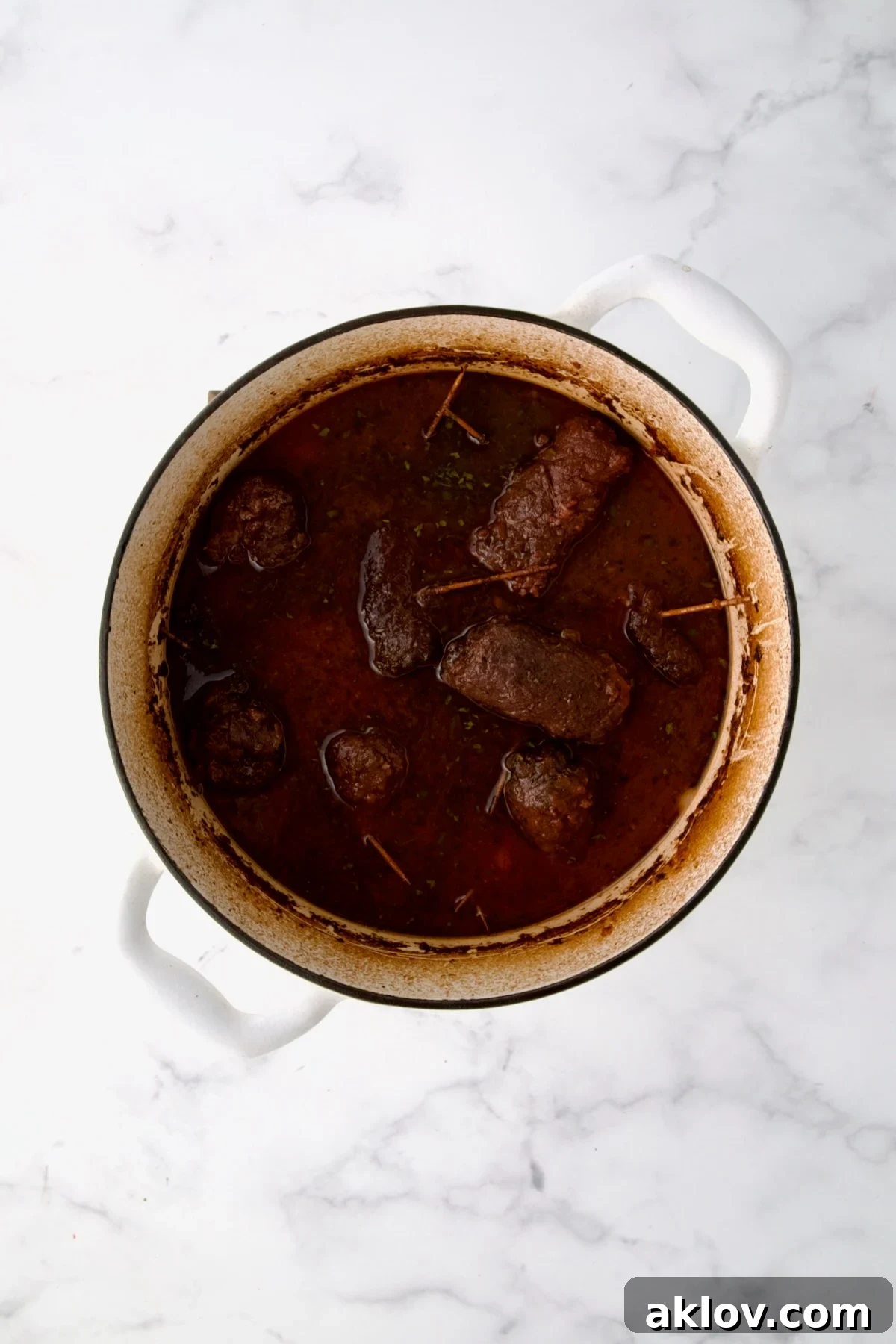
- Once the braciole is tender, carefully transfer the beef rolls to a warm platter. Tent them loosely with aluminum foil to keep them warm. Before serving, remember to remove all toothpicks.
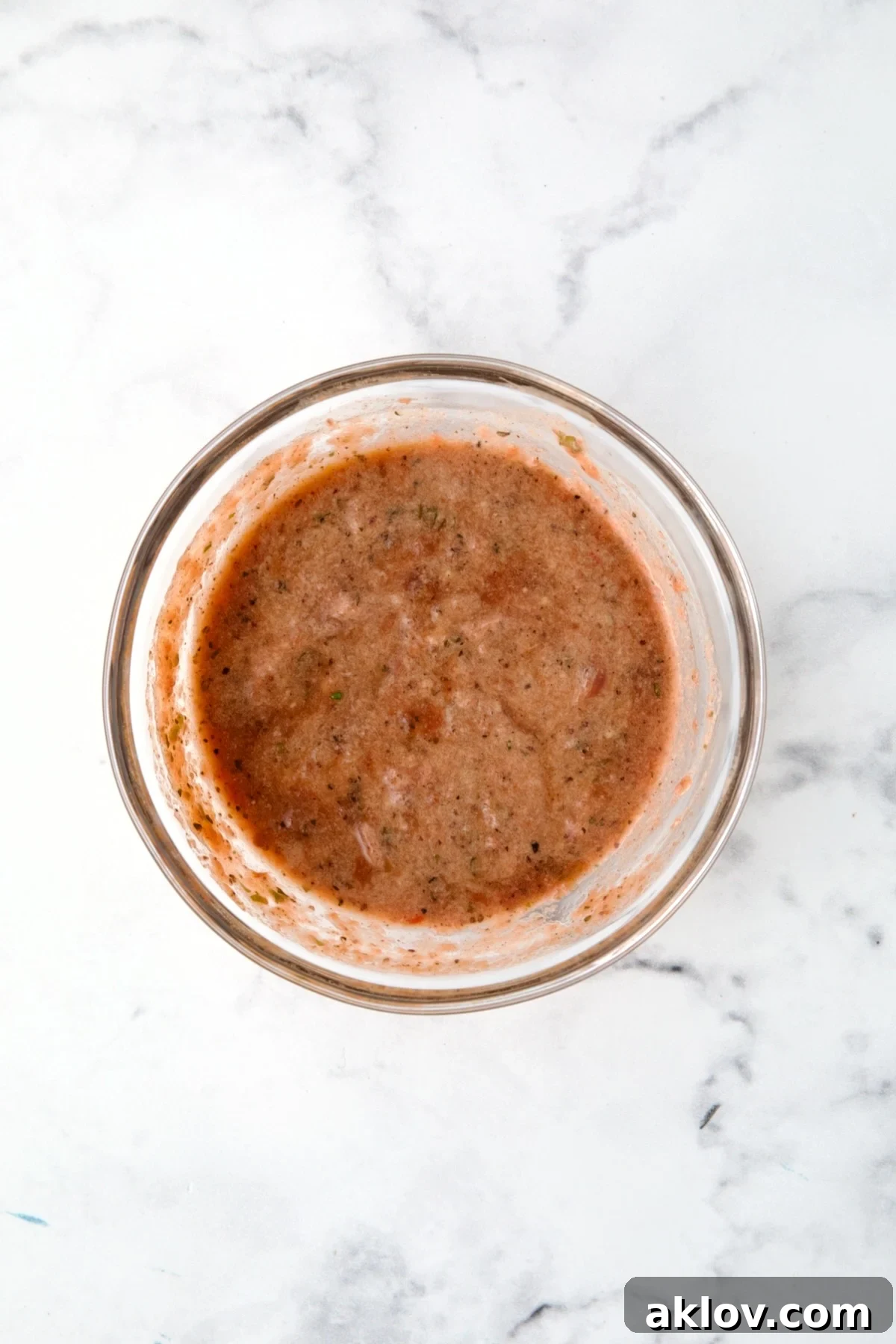
- Return the Dutch oven with the remaining sauce to the stovetop. In a small, heat-proof bowl, place the all-purpose flour. Ladle a small amount of the hot cooking liquid into the bowl with the flour and stir vigorously until you have a smooth, lump-free slurry. Slowly add this slurry to the simmering sauce in the pot, stirring constantly. Bring the sauce to a gentle simmer and cook for a few minutes, allowing it to thicken to your desired consistency.
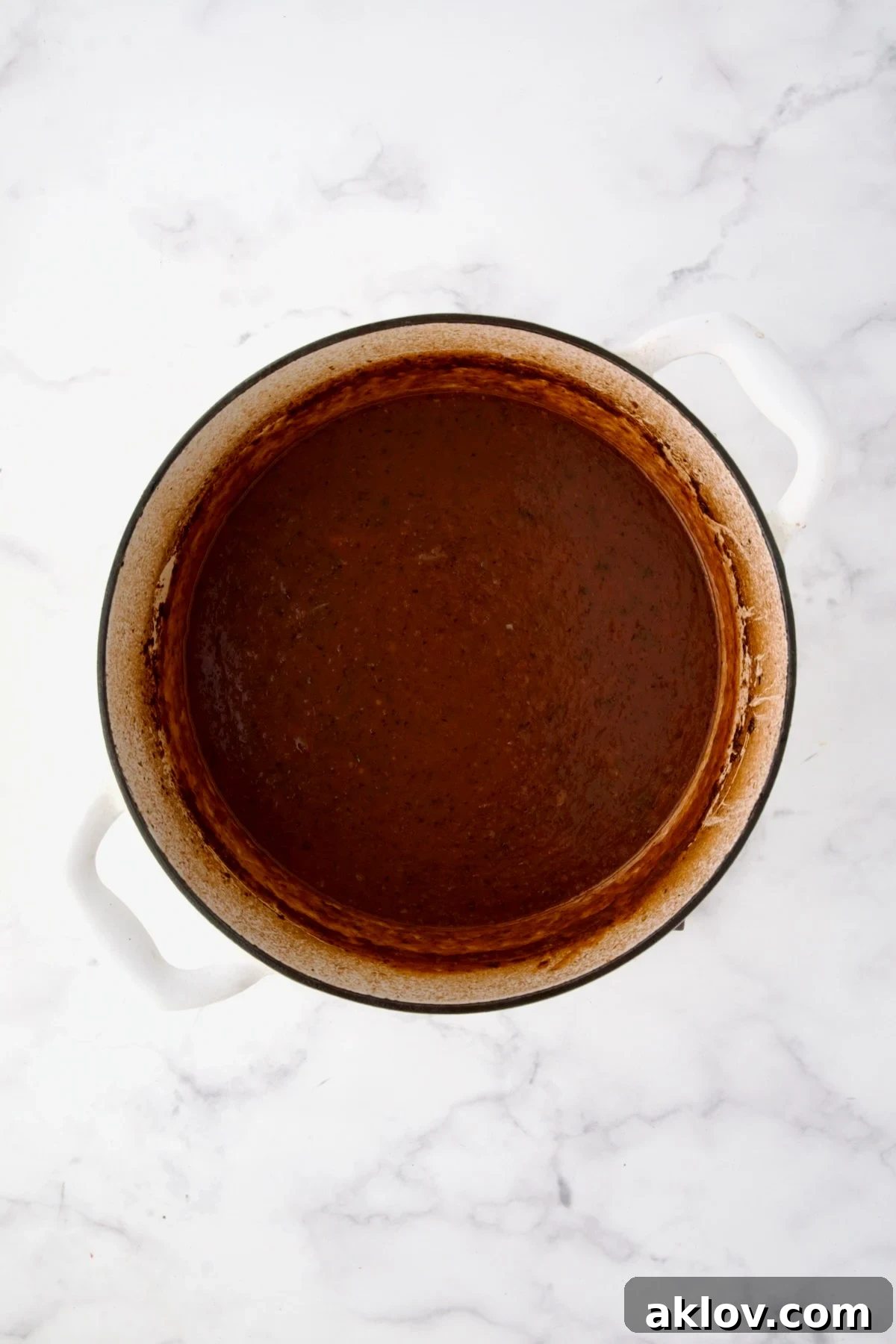
- Taste the sauce and adjust seasonings as needed with salt and freshly ground black pepper. If the tomatoes are a bit acidic, add a tiny pinch of sugar to balance the flavors.
- Carefully pour the rich, thickened sauce over the waiting beef rolls on your platter. For a fresh touch and vibrant color, garnish generously with chopped fresh parsley.
- Serve your exquisite Beef Braciole immediately over your favorite pasta, creamy polenta, or fluffy mashed potatoes. Offer additional grated Parmesan or Romano cheese at the table for those who desire more savory goodness.
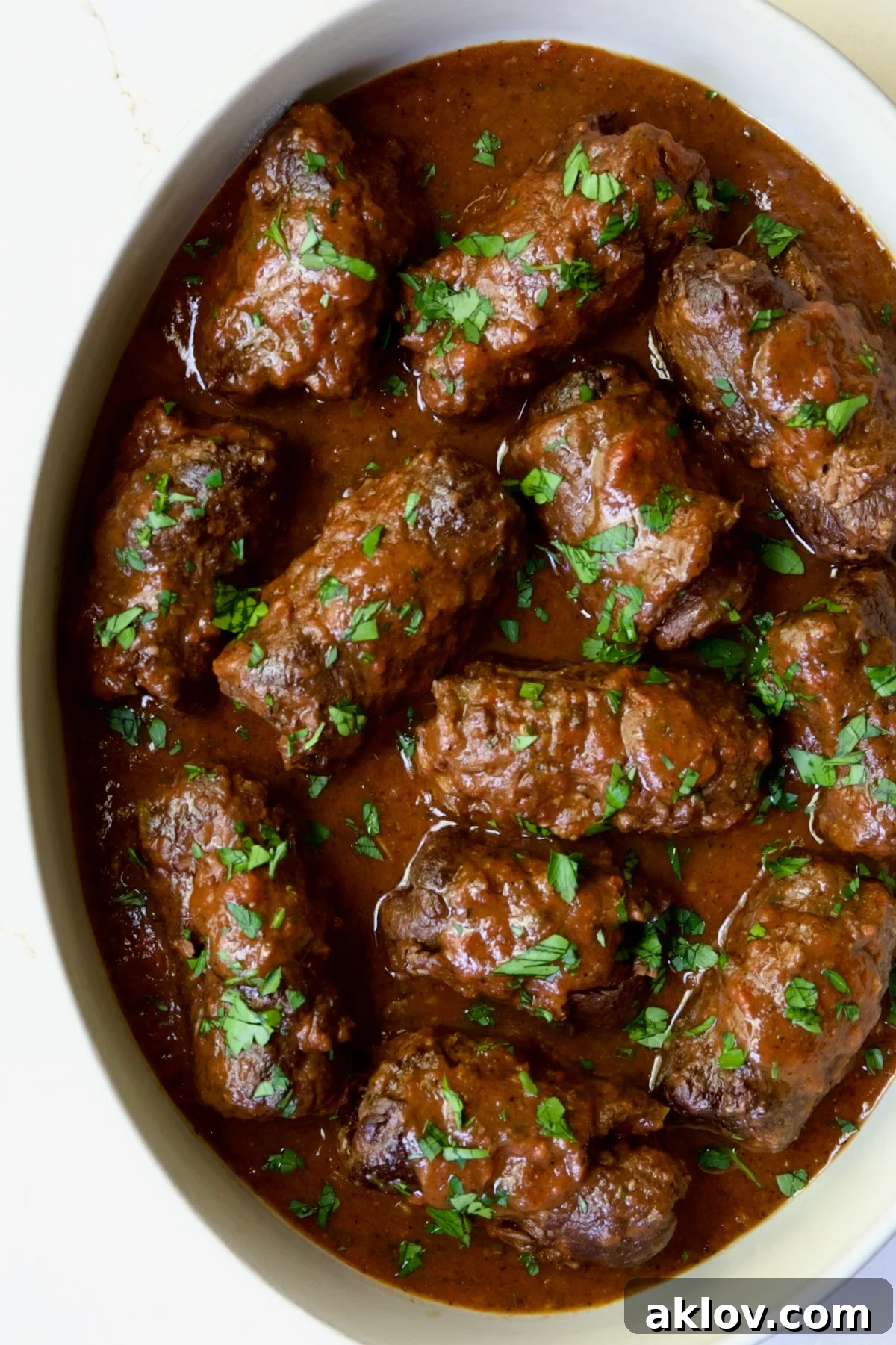
And there you have it – your very own authentic Italian Beef Braciole, ready to impress!
Chef Tips and Tricks for Perfect Braciole:
- **Pounding the Meat:** When tenderizing your braciole meat, always place a zipper-top plastic bag or plastic wrap over the beef. The double thickness of the bag will protect your countertop and contain any meat juices, making cleanup much easier. Plastic wrap is an option, but it tends to be flimsier and tears more easily than a sturdy zipper bag.
- **Efficient Assembly:** If you have a generously sized work surface, laying out all 12 pounded beef pieces (or at least six at a time) on freezer paper or parchment paper can significantly speed up the pounding, stuffing, and rolling process. This allows you to visually distribute the filling evenly across all pieces. For food safety, always avoid placing raw meat directly on your countertop.
- **Sealing the Braising Vessel:** The key to perfectly tender braised beef and a rich, concentrated sauce is to prevent excessive liquid evaporation during cooking. Before placing your Dutch oven in the oven, crumple a piece of parchment paper, run it under the faucet, and shake off any excess water. Place this dampened parchment paper directly over the surface of the sauce and beef, then cover tightly with the lid. The damp paper creates an extra seal, locking in moisture. Aluminum foil can also be used effectively for this purpose.
- **Sauce Consistency:** If you’re cooking your Beef Braciole on the stovetop, keep in mind that the sauce will naturally reduce and thicken more efficiently due to direct heat exposure. In this scenario, you might find that you don’t need to add the flour slurry at the end to achieve the desired thickness. Always assess the sauce before deciding to thicken it further.
- **Flavor Development:** For an even deeper flavor, consider making your braciole a day in advance. As with many slow-cooked dishes, the flavors tend to meld and intensify beautifully overnight in the refrigerator. Simply reheat gently when ready to serve.
Smart Money-Saving Tips for Braciole Recipes:
- **Choose Domestic Prosciutto:** While imported Italian prosciutto is exquisite, domestic prosciutto offers a fantastic flavor profile at a more accessible price point. For a dish like braciole where the prosciutto is cooked within a sauce, the subtle differences between domestic and imported varieties are often less noticeable, making domestic a smart choice for savings.
- **Slice Your Own Beef:** If you own a meat slicer, purchasing a whole top round roast and slicing it yourself can lead to significant savings. Grocery stores often charge a premium for pre-sliced or “Milanesa” cuts due to the added labor. To make slicing easier, partially freeze the roast for 45 minutes to an hour; this firms up the meat, allowing for cleaner, more uniform slices. An added benefit is that you can control the thickness of each slice, ensuring consistency for your braciole.
- **Buy in Bulk:** Keep an eye out for sales on top round roasts or quality crushed tomatoes. Buying these ingredients in larger quantities when they are on offer can reduce your overall cost per serving.
- **Homemade Breadcrumbs:** Instead of buying Italian breadcrumbs, you can easily make your own from stale bread. Simply process bread slices in a food processor until fine, then toast them lightly in the oven. Season with dried oregano, basil, garlic powder, and a pinch of salt and pepper for a cost-effective and flavorful alternative.
Frequently Asked Questions About Beef Braciole:
How do you cook Italian Beef Braciole on the stovetop?
To prepare braciole on the stovetop, ensure your pot is heavy-bottomed to distribute heat evenly. After browning the beef rolls and deglazing the pan, add all the sauce ingredients. Cover the pot tightly and cook on very low heat, maintaining a gentle simmer, for approximately 1 1/2 hours, or until the beef is fork-tender. It’s crucial to avoid a rapid boil, as this can toughen the meat. The goal is a consistent, slow braise. When cooking on the stovetop, the sauce naturally reduces more, so you might find you don’t need the flour slurry to thicken it at the end.
Can you cook Beef Braciole recipes in a slow cooker?
Absolutely! The slow cooker is an excellent method for braciole. First, follow the instructions for assembling the rolls, browning them, and deglazing the pot to build flavor. Then, transfer the browned braciole and the sauce into your slow cooker. Cook on high for 3 to 4 hours, on medium for 5 to 6 hours, or on low for 7 to 8 hours. Slow cookers tend to trap steam, which can sometimes dilute flavors. To counteract this, prop the lid open slightly during the last hour of cooking to allow some steam to escape, helping the sauce to reduce and its flavors to concentrate.
Can you make Beef Braciole ahead of time?
Yes, Beef Braciole is a fantastic make-ahead dish, offering several convenient options:
- **Option 1 (Assembly Stage):** Assemble the beef braciole rolls (pound, fill, and secure with toothpicks) up to the point of browning. Cover them tightly and refrigerate for up to 24 hours. When you’re ready to cook, proceed directly to the browning and braising steps.
- **Option 2 (Pre-Braise Stage):** Complete all steps up to returning the braciole to the pot with the sauce, just before placing it in the oven. Allow the liquid to cool completely, then place the entire pot (covered) in the refrigerator. When it’s time to cook, transfer the pot directly to the oven. You will need to add extra cooking time to account for the chilled pot and ingredients.
- **Option 3 (Fully Cooked):** Cook the Beef Braciole entirely, cool it thoroughly, and then refrigerate. This is how I frequently prepared it for my personal chef clients. When you’re ready to serve, gently reheat the dish in the oven, on the stovetop, or in a slow cooker until warmed through.
Can you freeze Beef Braciole?
Yes, Beef Braciole freezes wonderfully! Allow the cooked braciole and sauce to cool completely. Transfer it to an airtight, freezer-safe container. It can be stored in the freezer for 1 to 2 months. To serve, thaw the frozen braciole overnight in the refrigerator, then reheat it gently in a 350-degree F (175°C) oven until heated through, ensuring the beef remains tender and the sauce is bubbling.
What to Serve with Your Beef Braciole:
Beef Braciole is a hearty main course that pairs beautifully with a variety of sides, absorbing the rich tomato sauce and creating a truly satisfying meal. Here are some classic and creative serving suggestions:
- **Pasta:** Serve over thick, tube-shaped pasta such as penne, ziti, rigatoni, or even tagliatelle, which are perfect for catching the robust sauce.
- Cauliflower and White Bean Puree: A light yet creamy alternative to potatoes, offering a delicate flavor that complements the rich beef.
- Celery Root Puree: An elegant and earthy side that provides a unique taste and smooth texture.
- Spinach Parmesan Ranch Twice-Baked Potatoes with Parmesan Crumb Topping: A decadent potato dish that adds extra flavor and substance.
- Mashed Potato Casserole: Creamy, comforting mashed potatoes are always a perfect accompaniment to braised meats.
- **Creamy Polenta:** A classic Italian pairing, polenta is excellent for soaking up all the delicious sauce.
- **Crusty Italian Bread:** Don’t forget some crusty bread for dipping into the flavorful sauce!
- **Simple Green Salad:** A fresh, lightly dressed green salad provides a refreshing counterpoint to the richness of the braciole.
More Great Italian Beef Recipes You’ll Love!
If you enjoyed this Beef Braciole, you’ll surely love exploring more Italian-inspired beef dishes from my kitchen:
- Stracotto Recipe (Italian Pot Roast): A slow-cooked, tender pot roast bursting with Italian flavors.
- Grilled Marinated Skirt Steak with Peperonata: A vibrant and flavorful steak dish, perfect for grilling.
- Italian-Style Meatloaf: A comforting family favorite, reimagined with aromatic Italian herbs and cheese.
- Italian Stuffed Peppers: Bell peppers filled with a savory beef and farro mixture, baked to perfection.
Discover all my delectable beef creations at Beef Recipes – From A Chef’s Kitchen.
Rating: 4.55 from 633 votes
Beef Braciole Recipe
By Carol | From A Chef’s Kitchen
Beef Braciole (Braciola) is a classic, hearty, homestyle Italian-American dish perfect for a cozy Sunday dinner or whenever you want to make an impression! Thin slices of beef surround a savory filling slowly braised in a wine-infused sauce for a comforting yet elegant dish.
Prep Time: 30 mins
Cook Time: 2 hrs
Total Time: 2 hrs 30 mins
Servings: 6
Equipment
- Wusthof Chef Knife
- Cutting Board
- Glass Mixing Bowls
- Dutch Oven
Ingredients
- 6 thin slices boneless top round, about 2 pounds, preferably sliced 1/8-inch to 1/4-inch thick
- 12 large cloves garlic (4 minced, 8 sliced)
- 1/2 cup chopped Italian (flat-leaf) parsley, (approximately 1 small bunch), plus more for garnish
- 1 cup shredded Parmesan or Romano cheese, plus more for serving if desired
- 2 tablespoons seasoned dry breadcrumbs
- Salt and freshly ground black pepper, to taste
- 12 thin slices prosciutto
- 2 tablespoons olive oil
- 2 cups dry red wine (Cabernet, Pinot Noir, or Merlot)
- 2 cups beef broth
- 1 can (28-ounce) crushed tomatoes, preferably a good imported Italian brand such as Mutti or San Marzano
- 2 teaspoons dried Italian seasoning
- 2 tablespoons all-purpose flour (optional, for thickening)
- Pinch sugar, if needed (to balance acidity)
Instructions
- Preheat oven to 325 degrees Fahrenheit (160°C).
- Cut the top-round slices in half widthwise to have 12 equal pieces. Place the beef on a cutting board or other flat surface. Place a zipper-top bag over each beef slice and gently pound to 1/4 to 1/8-inch thickness.
- Mince 4 cloves of garlic; slice the remaining 8 cloves.
- In a small bowl, combine the minced garlic, parsley, cheese, breadcrumbs, salt, and black pepper to taste.
- Place a prosciutto slice over each piece of beef, then sprinkle the filling evenly over the prosciutto (2-3 tablespoons per slice).
- Roll the beef into a cylinder, tucking in the sides to hold in the filling as you roll. Secure with toothpicks.
- Heat the olive oil in a Dutch oven or large pot over medium-high heat. Working in two batches of six each, place the beef rolls in the pot, seam side down first, which will help to seal it. Cook, turning the meat occasionally until each roll is nicely browned on all sides, adjusting the heat as necessary to prevent burning. Transfer to a plate and repeat with the remaining six rolls.
- Add the wine to the Dutch oven. Bring to a boil, scraping up any browned bits. Let the wine boil for 2-3 minutes to reduce it and cook off some alcohol.
- Add beef broth, tomatoes, sliced garlic, and Italian seasoning. Return the beef rolls to the pot and bring back to a simmer.
- **OVEN:** Place a dampened piece of parchment paper (or aluminum foil) over the Dutch oven, then place the cover over the pot. Place in the oven and cook for 1 1/2-2 hours, turning the rolls after 1 hour. (My sweet spot for tenderness is usually around 1 hour and 45 minutes).
**STOVETOP:** Cover and cook on low heat, occasionally turning until beef is tender and easily pierced with a fork, about 1 1/2 hours.
**SLOW COOKER:** 3-4 hours on high, 5-6 hours on medium, or 7-8 hours on low. Prop the lid up towards the end to allow some of the steam to escape and the flavor to concentrate. - Transfer the beef braciole to a platter and tent with foil to keep warm. Remove the toothpicks.
- Place the pot back on the stove. Put the flour in a heat-proof bowl, then remove some of the hot cooking liquid. Stir until smooth to create a slurry. Slowly add the slurry to the liquid in the pot, bring to a slow simmer, and cook until thickened (if needed).
- Season with salt and black pepper to taste. Add a pinch of sugar if needed. Pour the sauce over the beef rolls on the platter. Garnish with chopped fresh parsley. Serve over pasta, potatoes, or polenta with additional grated cheese if desired.
Recipe Notes
SUBSTITUTIONS:
- To save money, use domestic prosciutto rather than imported Italian prosciutto.
- If you prefer not to use alcohol, substitute beef broth for the wine with 2 tablespoons of balsamic vinegar. Add more to taste after the beef braciole is cooked. Red wine vinegar is another option.
TIPS:
- When pounding/tenderizing braciole meat, place a zipper-top plastic bag over it. The double thickness will withstand pounding all 12 pieces.
- Sealing the cooking vessel with aluminum foil or parchment paper before placing it in the oven is key so the liquid doesn’t evaporate too much. However, some reduction will take place.
- If cooking on the stovetop, you may not need the flour to thicken the sauce because the sauce will reduce naturally as it simmers.
MAKE AHEAD (3 Options):
- Get the beef braciole/rolls/roulades assembled to the point of browning. Cover and refrigerate. When ready to cook, proceed with the browning and braising.
- Get everything done to the point of placing it in the oven. Cool the liquid, place the meat in the braising liquid and refrigerate. When ready to cook, place it in the oven. You’ll need to add extra time if the pot is cold out of the refrigerator.
- Cook and cool everything, then refrigerate until needed. When ready to serve, reheat in the oven, stovetop, or slow cooker.
FREEZER-FRIENDLY:
- Cool thoroughly, then place in an airtight container. Store in the freezer for 1-2 months. Thaw in the refrigerator, then reheat in a 350-degree oven until heated.
Nutrition Information (Estimated Per Serving)
Nutritional values are automatically calculated using unbranded products and are estimates only. Actual results may vary based on ingredients used and portion sizes. Adjust as needed for dietary restrictions, allergies, or health concerns.
- Serving Size: 2
- Calories: 570 kcal
- Carbohydrates: 8g
- Protein: 63g
- Fat: 24g
- Saturated Fat: 8g
- Polyunsaturated Fat: 2g
- Monounsaturated Fat: 11g
- Trans Fat: 1g
- Cholesterol: 163mg
- Sodium: 832mg
- Potassium: 1006mg
- Fiber: 1g
- Sugar: 1g
- Vitamin A: 584 IU
- Vitamin C: 9mg
- Calcium: 275mg
- Iron: 6mg

Like this recipe? Leave a comment below!